
Paraphrasing vs Rewording vs Summarizing: What's the Difference?

Thu
AI SEO Specialist, Full Stack Developer

Paraphrasing, rewording, and summarizing all involve rewriting text, but they are not interchangeable.
People often use the terms loosely because all three change the wording of an original passage. The difference is in how much of the original detail you keep and what the end result is supposed to do.
If you are trying to decide which approach fits your draft, this guide breaks down the difference in plain English and shows when each one makes sense.
The short version
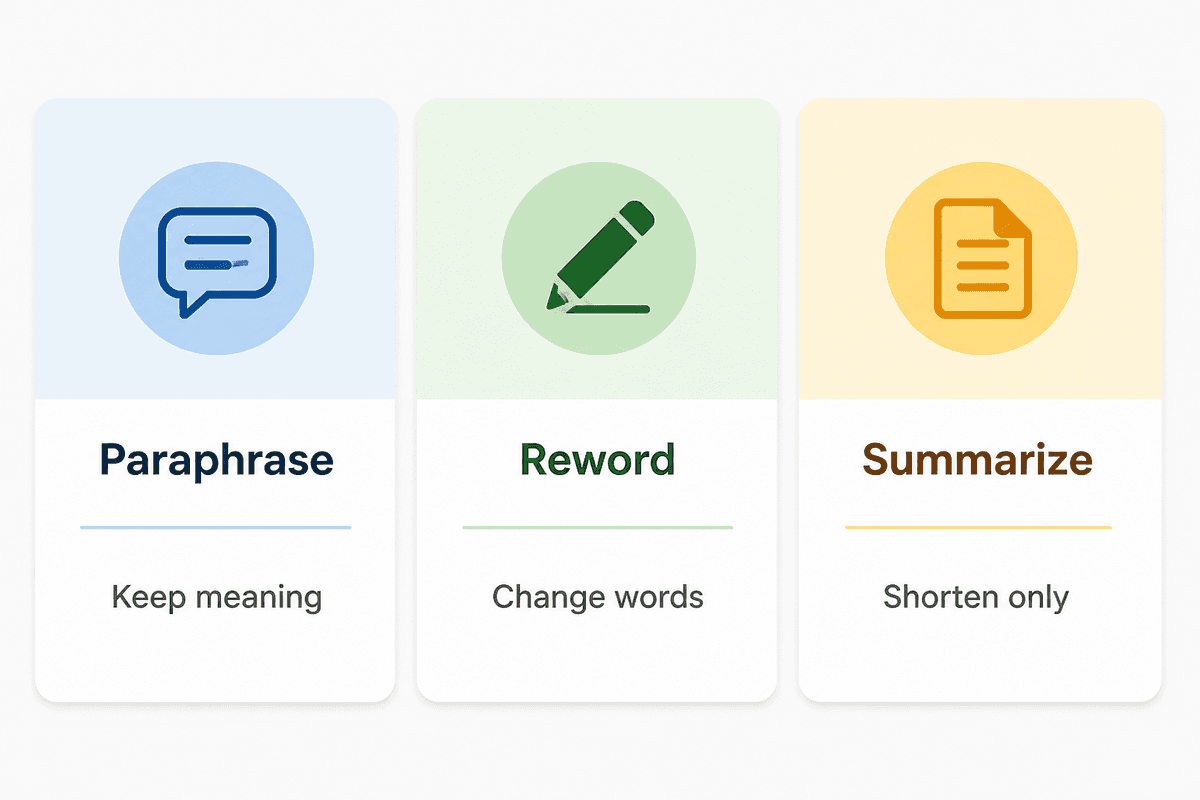
Here is the simplest way to separate them:
| Method | What stays | What changes | Best use case |
|---|---|---|---|
| Paraphrasing | The full idea and most of the detail | Wording and often structure | You need a fuller rewrite without changing the meaning |
| Rewording | The idea and most of the structure | Phrasing, tone, and awkward wording | You want a lighter cleanup of text that mostly works |
| Summarizing | The core takeaway only | Length, detail, and supporting points | You need a shorter version of longer material |
That sounds straightforward, but in practice the lines blur. The easiest way to keep them straight is to focus on the goal.
What is paraphrasing?
Paraphrasing means restating a passage in new language while keeping the original meaning and most of the important detail.
You are not trying to make it shorter by default. You are trying to make it different, clearer, or better suited to a new audience without distorting the message.
If you want help producing a full rewrite while preserving intent, a paraphraser is the closest match.
Use paraphrasing when:
- you need a fresh version of a sentence or paragraph
- you want to improve flow without changing the meaning
- you are adapting source material into your own wording
- you want a clearer rewrite of an existing passage
What is rewording?
Rewording is often a narrower version of paraphrasing.
In many cases, it means adjusting wording without changing the structure very much. You might replace clunky phrases, smooth out tone, or make a sentence sound less repetitive. The underlying idea stays the same, but the changes are usually lighter.
If that is your goal, a reworder may be a better fit than a full paraphrasing workflow.
Use rewording when:
- the draft already works but sounds awkward
- you want a cleaner version of one sentence
- you need a quicker tone adjustment
- you want to reduce repetition without rewriting everything
What is summarizing?
Summarizing means reducing a longer passage to its essential points.
You do not keep every example, qualifier, or detail. You strip the material down so the reader can understand the main idea faster. That makes summarizing useful for study notes, executive recaps, research overviews, and content briefs.
If your priority is compression rather than phrasing, a text summarizer is the better tool category.
Use summarizing when:
- the original text is too long
- you only need the key points
- you are creating notes or a content brief
- you want a faster overview before deeper reading
Paraphrasing vs rewording vs summarizing in one example
Here is the difference with the same source text.
Original
Many SaaS companies improve retention by simplifying onboarding, reducing time to value, and giving users clearer guidance during the first few sessions.
Paraphrased
SaaS companies often keep more users by making onboarding easier, helping people reach value faster, and offering clearer direction during their first few product sessions.
Reworded
Many SaaS companies boost retention by making onboarding simpler, speeding up time to value, and giving users clearer guidance early on.
Summarized
Better onboarding helps SaaS companies retain users.
This example makes the distinction clearer:
- the paraphrase keeps nearly all the detail
- the reworded version stays closer to the original and changes less
- the summary compresses the idea to one essential takeaway
Which one should you use?
Start with the outcome you need.
| Goal | Use | Don’t use |
|---|---|---|
| Keep full meaning, new wording | Paraphrase | Summarize (too short) |
| Light wording polish | Reword | Paraphrase (overkill) |
| Compress to key points | Summarize | Reword (won’t shorten enough) |
These are different jobs. Mixing them up is how students and SEO drafts get flagged.
Use paraphrasing when you want a fuller rewrite. Use rewording when the text mostly works and only needs cleanup. Use summarizing when the real problem is length.
There is also a practical workflow angle here. Many writers start with paraphrasing or rewording, then use a readability or editing pass to polish the result. If the draft still feels stiff after rewriting, tools like a readability improver or text simplifier can help make it easier to scan and understand.
If you want a deeper look at paraphrasing itself, these guides on paraphrasing examples and how to paraphrase without plagiarizing are the most useful next reads.
Common confusion to avoid
One reason these terms get mixed up is that AI tools often bundle them together under the same interface. That is convenient, but it can hide the underlying writing goal.
Two mistakes show up often:
- using summarizing when you actually need to preserve detail
- using light rewording when a deeper paraphrase is needed
If your version still looks too close to the source, you probably needed paraphrasing rather than simple rewording. If your version is still too long, you probably needed summarizing instead. And if it sounds polished but oddly flat, a light humanizer pass may help smooth the phrasing without changing the point.
Final takeaway
Paraphrasing, rewording, and summarizing are related, but they solve different problems.
Paraphrasing rewrites the full idea. Rewording cleans up the phrasing. Summarizing reduces the text to the essentials.
Once you separate them by purpose, it gets much easier to choose the right method and the right tool for the job.