
Free SWOT Analysis Generator
Generate a structured SWOT analysis for a business, product, campaign, department, or project. Add your goal, audience, competitors, and constraints to create strengths, weaknesses, opportunities, threats, and practical next steps you can use in planning.
SWOT Analysis
Your SWOT analysis will appear here...
How the AI SWOT Analysis Generator Works
Get results in seconds with a simple workflow.
Describe What You’re Analyzing
Enter your business, product, project, or campaign. Add optional industry and goal details so the SWOT analysis matches your situation and strategy needs.
Add Context (Optional) for Better Specificity
Include target audience, competitors, channels, budget, or constraints. The more real-world context you provide, the more actionable the SWOT insights become.
Generate and Turn It Into an Action Plan
Get a structured SWOT analysis you can paste into a doc or deck. Use the recommendations to prioritize initiatives, refine positioning, and mitigate risks.
See It in Action
Example of turning a basic idea into a structured SWOT analysis with actionable insights.
Business: A small fitness studio.
Need a SWOT analysis to plan marketing.
SWOT Analysis — Small Fitness Studio
Strengths:
- Loyal community and strong member referrals
- Experienced coaches with niche class expertise (strength + conditioning)
- High-quality class experience with personalized feedback
- Strong local brand awareness within a 3-mile radius
Weaknesses:
- Limited marketing budget and inconsistent lead flow
- Schedule constraints (peak classes sell out; off-peak underutilized)
- Limited content marketing/SEO presence (low visibility on Google)
- Reliance on one acquisition channel (Instagram)
Opportunities:
- Local SEO growth via “near me” searches and optimized Google Business Profile
- Corporate wellness partnerships with nearby offices
- Intro offers and referral challenges to increase trial-to-member conversion
- Content strategy targeting beginner pain points and home workout searches
Threats:
- Low-cost gym chains competing on price
- Boutique studios expanding into the neighborhood
- Economic uncertainty reducing discretionary spend
- Platform dependency risk (social algorithm changes)
Prioritized next steps:
- Improve local SEO (GBP posts, reviews, service pages, class schedule schema)
- Launch a 14-day intro offer with referral incentive
- Add corporate packages and outreach cadence
- Create a content plan for beginner keywords + short-form video repurposing
Why Use Our AI SWOT Analysis Generator?
Powered by the latest AI to deliver fast, accurate results.
Instant SWOT Analysis for Any Business or Project
Generate a structured SWOT analysis (Strengths, Weaknesses, Opportunities, Threats) for a company, product, campaign, or initiative—ideal for strategic planning and stakeholder alignment.
Actionable, Non-Generic Strategic Insights
Produces practical, specific SWOT bullet points with strategy-minded framing (what it means, why it matters, and what to do next) without fluff or vague statements.
Competitive and Market-Aware Recommendations
Optionally incorporates competitor context, category dynamics, and differentiation angles to strengthen positioning and reduce go-to-market risk.
Prioritized Next Steps and Strategy Ideas
Converts SWOT findings into prioritized recommendations you can use for marketing strategy, product roadmap decisions, risk mitigation, and resource allocation.
Clear Formatting for Slides, Docs, and Business Plans
Outputs a clean SWOT layout with scannable bullets that’s easy to paste into a pitch deck, business plan, marketing plan, or internal strategy document.
Pro Tips for Better Results
Get the most out of the AI SWOT Analysis Generator with these expert tips.
Write strengths as proof-based advantages
The best strengths are specific and defensible (e.g., “90-day onboarding playbook” or “high repeat purchase rate”), not generic claims like “great customer service.”
Separate internal weaknesses from external threats
Weaknesses are inside your control (process, skills, budget). Threats are external (competition, regulation, market shifts). Keeping them distinct improves decision-making.
Use competitors to sharpen differentiation
Add 2–5 key competitors and note why customers choose them. This improves your SWOT’s opportunities/threats and helps craft stronger positioning and messaging.
Prioritize by impact and likelihood
Not all threats are equal. Rank items by business impact and probability, then focus on the top few that meaningfully change strategy.
Convert SWOT into 3–7 concrete initiatives
A SWOT is only useful if it becomes action. Turn insights into initiatives (owner, deadline, KPI) such as “Improve conversion rate,” “Launch new channel,” or “Reduce churn.”
Who Is This For?
Trusted by millions of students, writers, and professionals worldwide.
Generate a SWOT Analysis That Leads to Real Strategy Decisions
A SWOT analysis generator should do more than fill four boxes. The useful output is a SWOT matrix that helps you decide what to protect, what to fix, what to pursue, and what to avoid.
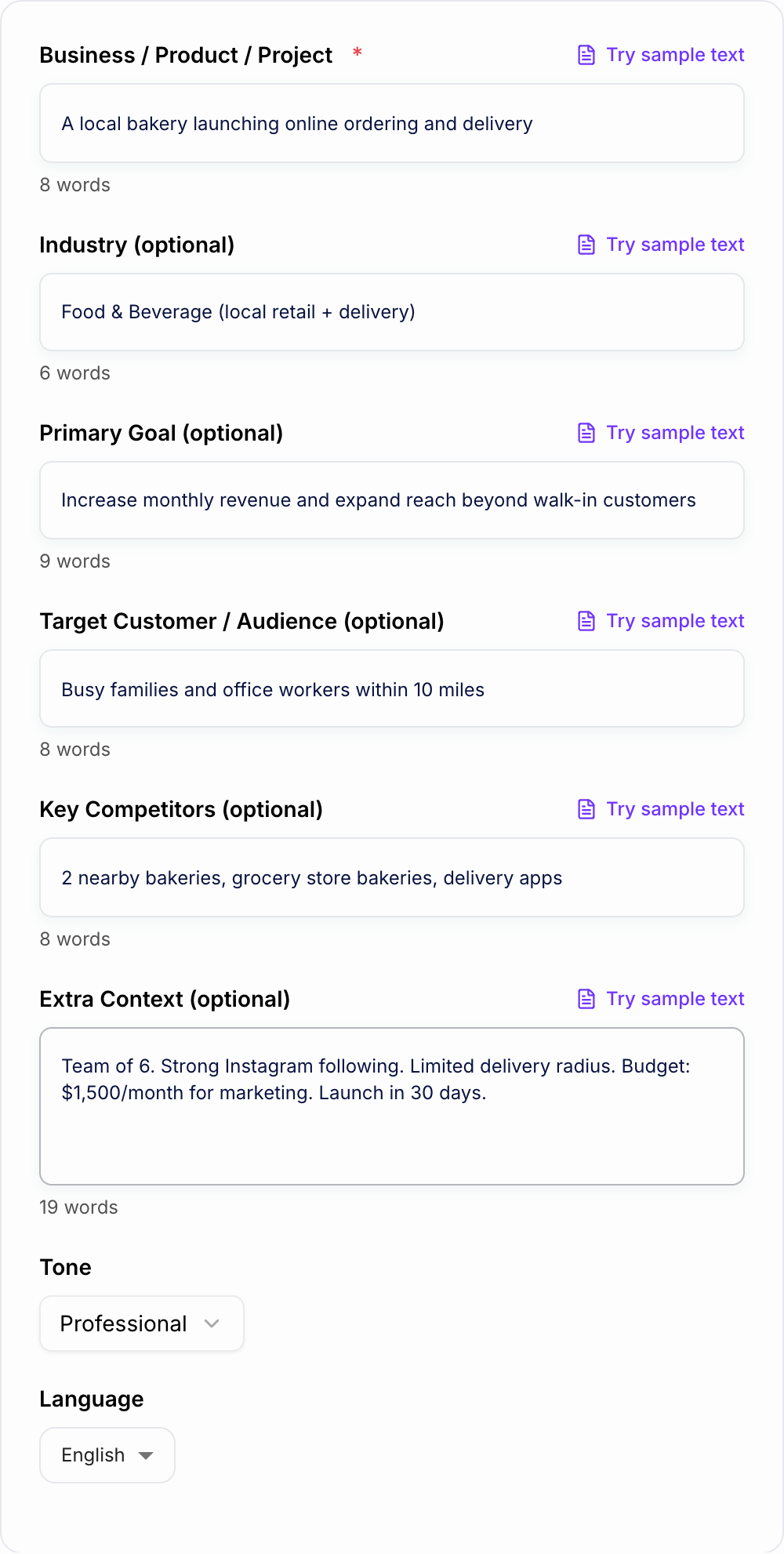
This AI SWOT Analysis Generator creates strengths, weaknesses, opportunities, threats, and next steps for a business, product, campaign, department, project, or strategic decision. The quality of the result depends on the context you provide.
What to Enter for a Sharper SWOT
If you only type "coffee shop" or "SaaS product," the generator can still create a SWOT, but it will be broad. Add details that make the analysis specific.
Include:
- the subject you are analyzing
- your main goal
- target audience or customer segment
- competitors or alternatives
- channels you rely on
- budget, team size, or timeline
- known constraints
- evidence from reviews, sales, churn, margins, or customer feedback
Example:
Subject: Local bakery launching online ordering
Goal: Increase monthly revenue and reach customers beyond walk-ins
Audience: Busy families and office workers within 10 miles
Competitors: Two nearby bakeries, grocery store bakeries, delivery apps
Context: Strong Instagram following, limited delivery radius, team of 6, marketing budget $1,500/month, launch in 30 days
That level of context gives the SWOT generator enough material to move past generic planning language.
How to Choose the Right SWOT Mode
Use Quick SWOT when you need a fast first draft for a meeting, workshop, or early planning session.
Use Detailed SWOT when you want more bullets, clearer implications, and a stronger recommendation section.
Use Competitive SWOT when differentiation matters. Add competitor names and why customers choose them.
Use Go-To-Market SWOT when the analysis is tied to a launch, campaign, pricing change, market entry, or channel strategy.
The mode should match the decision you need to make. A fundraising SWOT, product-launch SWOT, and internal-operations SWOT should not emphasize the same things.
How to Review the Generated SWOT
Start by separating facts from assumptions. A useful SWOT should be specific enough that someone can challenge it.
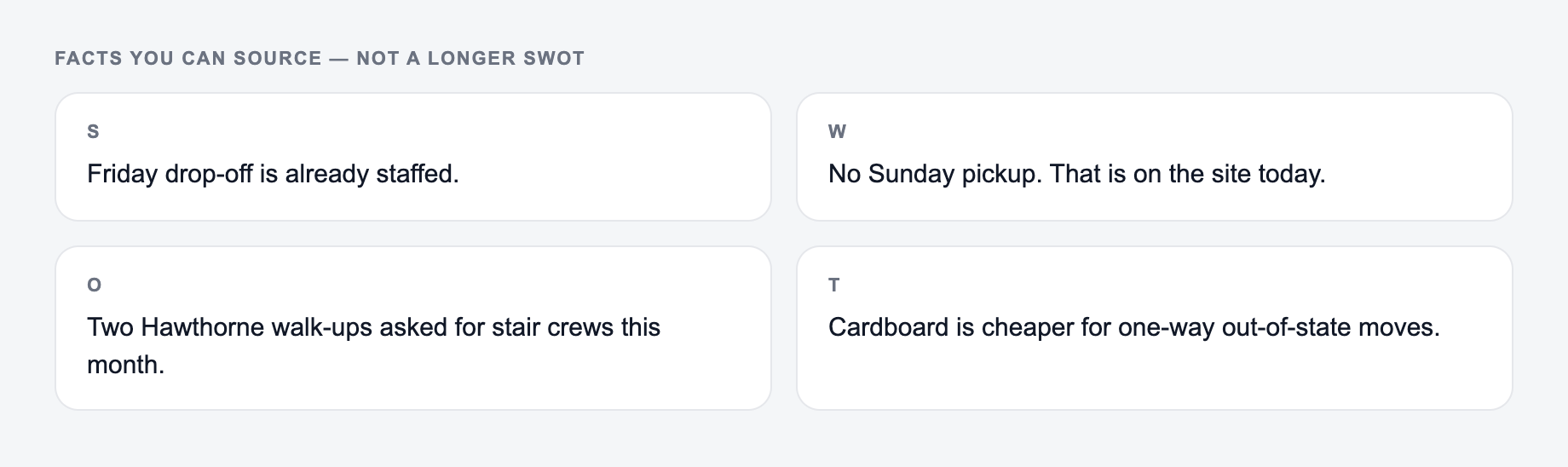
Facts you can source belong on the form. A longer SWOT is not a better decision.
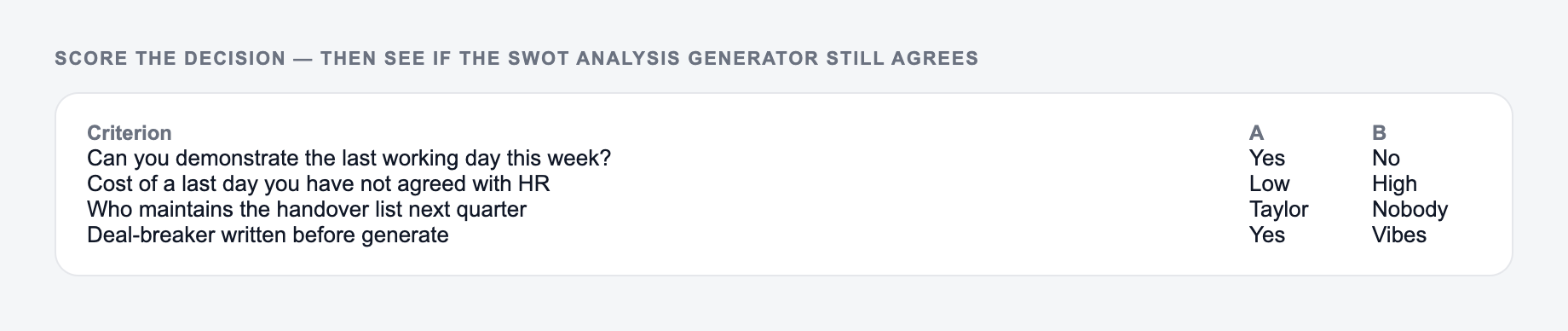
Option A looks complete. Option B is quieter. Completeness is not the criterion.
Ask: which option still works if the optimistic assumption is wrong? That is the line to keep from the AI SWOT Analysis Generator.
A longer list is not a better decision. Score what you will actually live with.
Weak bullet:
Strong brand
Better bullet:
High referral rate from existing customers, with 42 percent of new bookings coming from word of mouth
Weak bullet:
More marketing
Better bullet:
Opportunity to rank for local "same-day bakery delivery" searches that competitors are not targeting yet
After generation, remove vague bullets, combine duplicates, and add evidence where you have it.
Turn the SWOT into Action
The most important step happens after the matrix is generated. Use the four quadrants to create decisions:
- Strengths + Opportunities: What advantage can you use right now?
- Weaknesses + Opportunities: What must be fixed before growth is realistic?
- Strengths + Threats: What advantage helps you defend against risk?
- Weaknesses + Threats: What vulnerability could hurt most if the market turns?
Then choose three to seven initiatives. Assign each one an owner, deadline, and metric. Without that step, a SWOT usually stays in the deck and never changes the plan.
Common SWOT Generator Mistakes to Avoid
Score the decision you are actually making. A longer grid is not a better call.
- Treating internal weaknesses as external threats.
- Listing features as strengths without explaining why they matter.
- Writing opportunities as wishes instead of market openings.
- Letting the generator create too many priorities.
- Keeping bullets that are not tied to the goal.
- Presenting the SWOT without evidence or next steps.
If the SWOT leads into a broader business plan, campaign, positioning exercise, or planning document, Junia AI can help turn the same raw context into other structured strategy drafts.
Final Checklist Before You Use the SWOT
Good comparison vs a decorative one:
-
Good: two options, four criteria you will live with, and the limitation you are accepting.
-
Bad: a twelve-row matrix with empty scores and a winner you already liked.
-
The subject and goal are clear.
-
Strengths and weaknesses are internal.
-
Opportunities and threats are external.
-
Important bullets are backed by evidence or a reasonable signal.
-
Generic items have been rewritten or removed.
-
The final next steps are prioritized.
-
Each action has an owner, deadline, and metric.
A generated SWOT is a starting point. The strategic value comes from editing it against reality and turning the best insights into decisions.
Frequently Asked Questions
What is a SWOT analysis?+
A SWOT analysis is a strategic planning framework that evaluates Strengths, Weaknesses, Opportunities, and Threats. It helps you understand internal capabilities (strengths/weaknesses) and external factors (opportunities/threats) to make better decisions.
How do I use a SWOT analysis to create a strategy?+
After listing SWOT factors, translate them into actions: use strengths to capture opportunities, fix or reduce weaknesses, defend against threats, and prioritize initiatives by impact and effort. A good SWOT should end with clear next steps.
What should I enter for the best SWOT analysis output?+
Start with your business or project description. If you can, add your goal, target audience, competitors, and any constraints (budget, timeline, channels). More context helps generate more specific and actionable SWOT points.
Can I generate a SWOT analysis for a product, brand, or marketing campaign?+
Yes. SWOT works for products, brands, campaigns, departments, and projects—not just entire companies. Use the subject field to specify what you’re analyzing (e.g., “Email marketing program” or “New subscription tier”).
Is the SWOT analysis accurate and ready to present?+
It’s a high-quality first draft based on the information you provide. Review and adjust items to reflect real data (market research, customer feedback, financials). For best results, validate assumptions and add evidence.
How many items should each SWOT quadrant include?+
For most use cases, 5–10 bullets per quadrant is enough. Too many items can dilute focus. Prioritize the highest-impact factors and consolidate similar points.