
Why ChatGPT Sounds Like Clickbait — and How to Make AI Writing Sound Human

Thu
AI SEO Specialist, Full Stack Developer

You have probably had this moment.
You ask ChatGPT for a blog intro, or a LinkedIn post, or even just a nicer paragraph. And it comes back with something like:
“Unlock the hidden secrets to skyrocket your results in just 7 days.”
And you just sit there thinking. Why does it talk like a YouTube ad from 2016.
The weird part is it is not always wrong. It is just… loud. Smooth. Overconfident. Full of “game changing” and “you won’t believe” and “in today’s fast paced world.” It reads like generic SEO copy, or clickbait, or both. Even when you asked for calm, practical writing.
So let’s unpack what is actually happening, why it defaults to hype, and how to get human sounding output you would actually publish. If you are already trying to add a human touch to AI-generated content, this is really the root problem: the draft is often trying too hard before it has earned the tone.
Why AI defaults to hypey, clickbait phrasing
AI sounds clickbaity because engagement-shaped internet text is overrepresented in training. Your job is to reintroduce audience, constraints, and proof — not to ask for “more professional” alone.
This is not because the model is “trying to trick people.” It is because of incentives and training data. A few forces stack on top of each other.
1. It is rewarded for being helpful, fast, and confident
Most chatbots are tuned to be maximally helpful in a single response. That pushes them toward:
- Clear claims
- Strong verbs
- Confident tone
- Neat structure
But confidence without lived experience often becomes flattened confidence. Everything sounds equally certain. Everything sounds equally important. So you get big claims even when the topic is small.
Humans hedge naturally. We say “usually,” “depends,” “in my experience,” “here’s the tradeoff.” AI can do that, but it is not the default.
2. It pattern matches the internet’s highest engagement writing
A lot of public web copy is written to win attention. Headlines, listicles, landing pages, growth posts, affiliate content. The kind of stuff that performs.
Models learn patterns. If certain phrases are common in high performing copy, you will see them show up as safe, reusable templates.
Things like:
- “Here’s the truth about…”
- “Most people get this wrong…”
- “The ultimate guide to…”
- “This changes everything…”
- “In this comprehensive article…”
These are not always bad. But when they show up everywhere, they start to feel fake.
3. It overuses “marketing English” because it is broadly applicable
Generic SEO writing is generic for a reason. It is portable.
If you say “leverage,” “optimize,” “streamline,” “boost,” “supercharge,” you can apply it to almost anything and it will still sound vaguely professional. That is useful when the model is unsure what you really want.
So it reaches for the safe corporate verbs.
4. Weak audience calibration makes it louder than it should be
When you do not specify who the reader is, the model tends to write for a broad audience. Broad audience means lowest common denominator. And lowest common denominator copy tends to lean hypey because it has to work without context.
A piece written for “SaaS marketers at Series A companies who already know SEO basics” should not sound like “SEO 101 that will blow your mind.” But if you never tell it who it is for, it will often drift toward mass appeal.
5. The “one shot answer” pushes it into packaged conclusions
ChatGPT often tries to finish the job for you. It wants to deliver a complete, tidy output.
That is why it loves:
- Overly clean intros
- Predictable subheads
- A summary that repeats everything
- Inspirational endings
It feels like content. But it does not feel like you.
The most common clickbait patterns AI spits out
| Clickbait pattern | Human rewrite move |
|---|---|
| “You won’t believe…” | State the concrete outcome |
| Vague “game-changer” | Name the mechanism |
| Fake urgency | Keep only real deadlines |
| Packaged conclusion | Show the tradeoff |
| Synonym soup | Put the noun + constraint back |
Once you see these, you cannot unsee them.
Pattern 1: The “secret” framing
- “The secret to…”
- “Hidden trick…”
- “What nobody tells you…”
Pattern 2: The instant transformation promise
- “Skyrocket results”
- “10x your traffic”
- “Explode your conversions”
- “Overnight”
Pattern 3: Fake urgency
- “Right now”
- “Before it’s too late”
- “Stop doing this immediately”
Pattern 4: Vague grand claims
- “Game changing”
- “Revolutionary”
- “Next level”
- “Powerful”
Pattern 5: The generic scene setting intro
- “In today’s digital world…”
- “Now more than ever…”
- “Businesses are constantly looking for…”
Pattern 6: Empty authority
- “Experts agree…”
- “Studies show…” (with no study)
- “Data proves…” (with no data)
Most of these are not inherently evil. They are just overused. And AI uses them like seasoning. On everything.
How prompts accidentally make it worse
A lot of the clickbait problem is prompt shaped. Not all of it, but a lot.
Here are common prompt habits that crank up the hype.
“Write a high converting post”
Conversion copy can be great. But if you do not define your brand voice and constraints, the model will default to the loudest version of conversion copy it has seen.
“Make it engaging”
Engaging, to a model, often means punchy hooks, big claims, curiosity gaps. Which is… clickbait adjacent.
“Write SEO optimized content”
If you do not add “avoid generic SEO language,” you will often get the template. The safe SEO structure with the same phrases you see everywhere.
“Add power words”
This basically guarantees “skyrocket,” “unlock,” “ultimate,” “proven,” “effortless.” You asked for it, it just followed.
“Write like Neil Patel / insert famous marketer”
You are telling it to pattern match high engagement marketing content. Again, not always wrong. But it often turns into a caricature.
The fix is not “stop using AI.” It is adding constraints and grounding.
You want two things:
- Constraints so it does not reach for hype by default.
- Grounding so it writes from real material instead of vibes.
If you also want the draft to sound more like your brand, pair those constraints with a clear voice reference. This is where a workflow for customizing AI brand voice helps. The model stops guessing what “good writing” means and starts following a more specific house style.
Let’s make that practical.
Prompt templates that reduce clickbait (copy and paste)
These are not magic prompts. But they push the model into a calmer, more human register.
Template 1: Human tone, no hype, specific reader
Paste this at the top of a chat.
You are helping me write in a human, non clickbait tone.
Audience: [who exactly]. They already know [baseline knowledge].
Goal: be useful and specific, not motivational.
Style rules:
- No hype words (game changing, ultimate, skyrocket, unlock, revolutionary, next level).
- No “secret” framing or curiosity bait.
- No “in today’s world” intros.
- Prefer concrete nouns and plain verbs.
- Use light hedging when appropriate (often, usually, depends).
- If you make a claim, add the reason or the mechanism.
Output: short paragraphs, slightly uneven human rhythm.
Topic: [topic].
Provide: 3 alternative openings, then an outline.
This does two important things. It defines the reader. And it bans the autopilot phrases.
Template 2: Source grounded writing (best for anything factual)
Write a draft using ONLY the information below. If something is missing, write “[needs source]” instead of guessing.
Tone: practical, calm, slightly skeptical. No hype.
Reader: [audience].
Source notes:
- [paste bullets, stats, links, product notes, interview notes, internal doc snippets]
Deliver: [format].
If you do this, the content instantly becomes less “SEO flavored” because it is anchored in your inputs.
Template 3: “Rewrite pass” prompt (when you already have a draft)
Rewrite this to sound like a real human wrote it. Keep meaning, improve clarity.
Remove: hype, generic marketing verbs, broad claims.
Add: specificity, mild caveats, and natural phrasing.
Keep it concise.
Text: [paste].
This is a great second pass even if you used a different tool for the first draft.
Tone constraints that actually work (quick list)
If you only remember one thing, remember this: banning phrases is surprisingly effective.
Add a small “ban list” to your prompt:
- No: unlock, skyrocket, game changing, ultimate, revolutionary, seamless, leverage, robust, cutting edge, transformative
- Avoid: in today’s digital landscape, now more than ever, businesses are looking to, at the end of the day
- No: “you won’t believe,” “what nobody tells you,” “secret”
And add a small “prefer list”:
- Prefer: explain the mechanism, show tradeoffs, use examples, write like an experienced coworker, short sentences sometimes, fragments ok.
Examples: clickbaity lines rewritten to sound human
Here is the part most people skip. The line editing.
Example 1
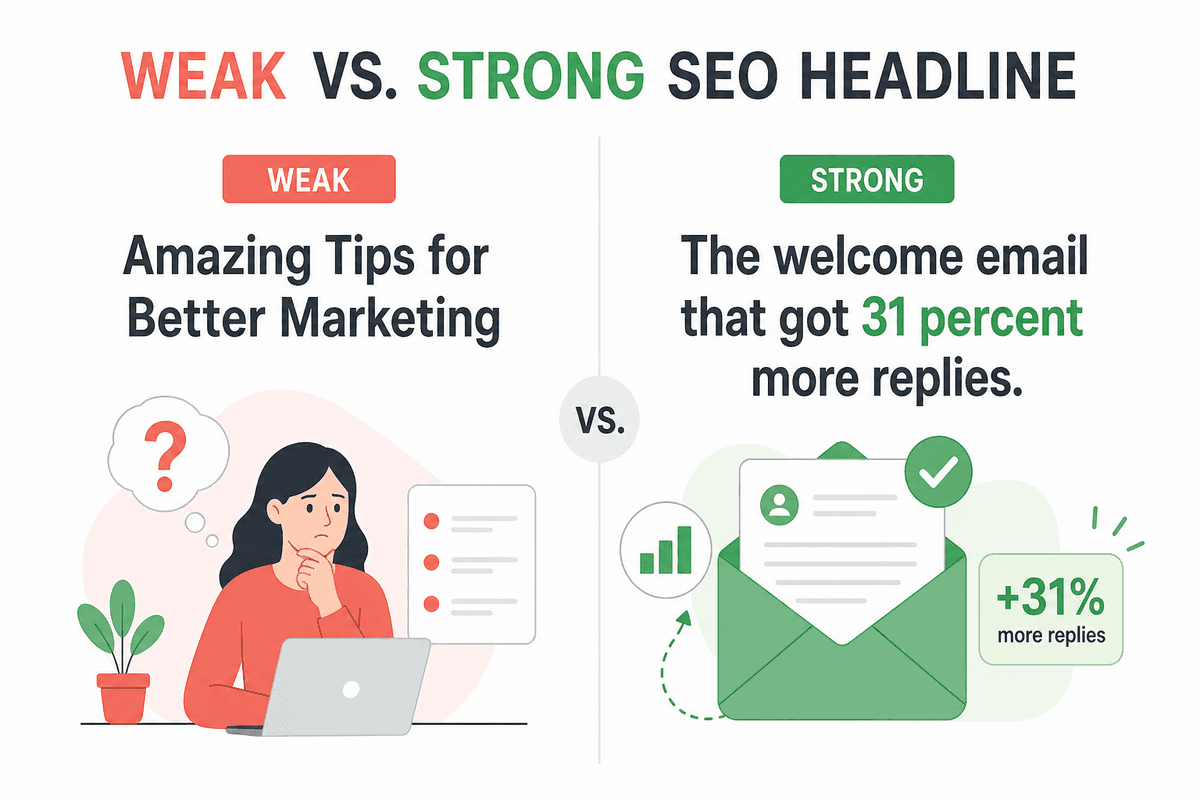
Clickbait: “Unlock explosive traffic growth with these proven SEO hacks.”
Better: “If your organic traffic has stalled, these are a few SEO fixes that usually move the needle. Not glamorous, just effective.”
Example 2
Clickbait: “This one strategy will 10x your conversions overnight.”
Better: “This can improve conversions, but only if your offer and targeting are already solid. Think of it as a multiplier, not a rescue plan.”
Example 3
Clickbait: “In today’s fast paced digital world, content is king.”
Better: “Most teams are publishing more than ever. The hard part is making a piece specific enough that a real reader actually saves it.”
Example 4
Clickbait: “Discover the secret framework top marketers don’t want you to know.”
Better: “There is no secret framework. There are a few repeatable steps that good teams do consistently, and they are mostly boring.”
Example 5
Clickbait: “The ultimate guide to AI writing that will change everything.”
Better: “Here’s a practical way to use AI for drafts without ending up with the same generic post everyone else publishes.”
Notice what changed. Less promise. More context. More honesty.
Editing checklist: turn chatbot output into publishable human copy
If you are a marketer or SEO and you are using AI daily, this checklist is the difference between “fine” and “credible.”
Pass 1: Kill the obvious tells
- Remove the big hype adjectives.
- Delete scene setting intros that say nothing.
- Cut repeated summaries.
Pass 2: Add calibration
- Who is this for, specifically.
- What do they already know.
- What should they do next, realistically.
A single line like “If you already have solid search demand and decent internal links, start here” makes it feel written by someone who has seen the movie before.
Pass 3: Replace generic verbs with real actions
Swap:
- leverage -> use
- optimize -> tighten, reduce, improve, rewrite, test
- streamline -> remove steps, automate, standardize
- boost -> increase (and say from what to what, if you can)
That one change alone usually improves readability fast, especially if you already have a habit of improving the readability of a blog post before publishing.
Pass 4: Force mechanisms, not claims
Any time you see a claim, ask:
- “Because what?”
- “How does that work?”
- “What is the tradeoff?”
Pass 5: Add one concrete example per section
Even a small one helps. A mini scenario, a quick snippet, a before and after, a number if you have it.
Pass 6: Make it sound like you
This is the part people want to outsource, but you cannot fully.
Add:
- a sentence you would actually say out loud
- a mild opinion
- a quick aside
- a small imperfection in rhythm
If you need a practical framework for that last pass, these guides on adding a human touch to AI-generated content and avoiding sloppypasta-style AI content are worth borrowing from.
Not sloppy. Human.
When raw chatbot output is the wrong workflow
If you are writing one email or brainstorming angles, ChatGPT is fine.
But if you are an SEO team trying to publish consistently, raw chatbot output starts to break down:
- It drifts across sections in long form.
- It repeats itself.
- It forgets your brand voice.
- It makes claims without sources.
- It does not naturally handle internal linking, content scoring, or SERP aligned structure.
- It produces “looks done” drafts that still need heavy editing.
At some point you want a dedicated long-form content workflow. Something that bakes in SEO structure, competitor context, linking, brand voice, and a cleaner path to publish.
That is where a platform like Junia.ai fits more naturally than a blank chat box. You can move from raw drafting into a more controlled workflow for brand voice, readability, and internal linking instead of fixing every paragraph by hand. If you have already compared AI vs. human writers, this is usually the practical middle ground: use AI for speed, then use process to keep the output credible.
A simple way to think about it:
- Chatbots are great for improvising.
- Content platforms are better for producing.
Quick wrap up
ChatGPT sounds like clickbait because it is trained on a lot of high engagement web writing, rewarded for confident helpful answers, and often forced to guess your audience and intent. The fix is not complicated, but it does require discipline.
- Add audience and tone constraints.
- Ground the draft in real sources.
- Ban the autopilot phrases.
- Edit with a checklist that forces specificity and mechanisms.
- And when you need consistent, controlled long form SEO content, use a workflow built for that, like Junia.ai, instead of relying on raw chatbot output.
If you want the shortest version of the fix, it is this: give the model a narrower audience, ban the obvious hype words, and revise the output like an editor, not a prompt collector. That one shift usually does more than chasing yet another “humanizer” prompt.
If you do just one thing today, do this: take your last AI draft, remove every hype word, and rewrite the first paragraph like you are explaining it to a smart coworker. The rest gets easier from there.