
Publishing AI Content in Bulk? Here's How Sites Get Wiped From Google

Yi
SEO Expert & AI Consultant

I do not think bulk AI content ruins a website because it is AI-written. The trouble starts when the publishing system creates hundreds of thin, similar, unverified pages that exist mainly to catch keywords.
That distinction matters. Google has said its systems focus on helpful, reliable content, not whether a page was produced by a person or with automation. But Google also names scaled content abuse as a spam pattern: generating many pages primarily to manipulate rankings while adding little or no value for users.
So the real question is not "Can I use AI for content?" The better question is: can I publish at this speed without losing originality, accuracy, editorial judgment, and reader trust?
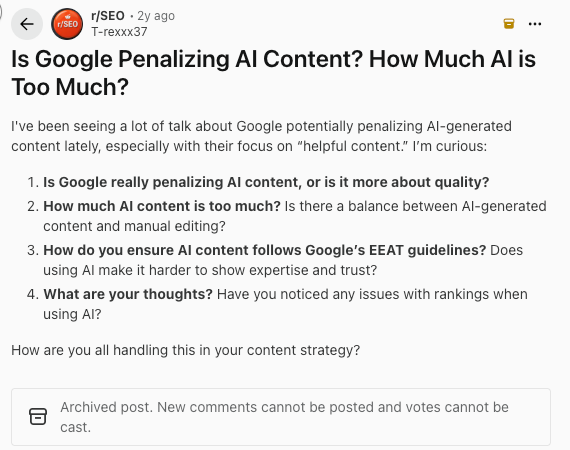
The confusion shows up in SEO communities too. In one r/SEO discussion about whether Google penalizes AI content, the useful questions were not about detection tricks. They were about quality, editing balance, E-E-A-T, and whether AI-assisted pages actually hold rankings.
In my experience, most risky bulk content programs fail that second test. They get the production math right and the editorial math wrong.
TL;DR: Bulk AI Content Is Risky When Scale Beats Quality
Here is the short version:
- Google does not have a blanket penalty for AI-written content.
- Google does target large volumes of low-value pages made mainly for search rankings.
- The riskiest pattern is publishing many similar articles with no first-hand input, no useful examples, weak sourcing, and no real editing.
- AI can be useful for research, outlines, drafts, briefs, translation, repurposing, and structured content workflows.
- The safer path is slower than "one-click publish": keyword validation, editorial review, fact-checking, original insight, internal linking, and post-publication pruning.
If you want to use bulk content generation, treat AI as a production assistant, not a publishing department. The moment your output outruns your ability to review it, your SEO risk starts compounding.
What Bulk Content Generation Actually Means
Bulk content generation is the process of creating many pieces of content at once, often from keywords, templates, prompts, product feeds, location data, or existing articles.
It can be useful. A SaaS company might need 200 help articles. An ecommerce site might need product descriptions. A global site might need localized landing pages. A blog might need outlines for a large content cluster. I do not have a problem with any of that when the source material is real and the review process is serious.
The problem starts when "bulk" becomes the strategy by itself.
If the plan is simply:
- Export thousands of keywords.
- Ask AI to write one article per keyword.
- Publish everything with minimal review.
- Wait for long-tail traffic.
That is not a content strategy. That is a quality-control problem waiting to show up in Search Console, usually after the team has already moved on to the next batch.
Google's guidance on generative AI content is pretty clear on this point: using AI to generate many pages without adding value for users may violate the scaled content abuse policy. The issue is not the model. The issue is the page's purpose and usefulness.
The Three Bulk AI Content Patterns That Usually Go Wrong
Most bad bulk AI strategies fall into one of these patterns.
| Pattern | What it looks like | Why it becomes risky |
|---|---|---|
| Keyword batch publishing | Hundreds of posts generated from a keyword list | Pages repeat the same advice with small wording changes |
| Programmatic page inflation | Thousands of location, product, or comparison pages from one template | The unique value per URL is too low |
| AI rewriting at scale | Existing articles scraped, summarized, translated, or spun into new posts | The site adds no original reporting, testing, or perspective |
None of these are automatically spam. Programmatic SEO, translation, and content refreshes can be legitimate. But they need real value added at the page level.
For example, a location page can work if it includes local pricing, regulations, customer examples, availability, service details, and useful comparisons. It becomes thin when only the city name changes.
The same applies to AI-written blog posts. A draft about "best CRM software for dentists" can be useful if it includes dental workflow constraints, HIPAA considerations, examples, pricing notes, and clear buyer tradeoffs. It becomes disposable when it simply paraphrases the same generic CRM advice as every other page.
Does Google Penalize AI Content?
No, not just because it is AI content.
Google's public guidance says it rewards high-quality content however it is produced. Its systems are meant to surface helpful, reliable, people-first information. That means an AI-assisted article can rank if it is useful, original, accurate, and trustworthy.
But there is an important second half to that answer.
Google's Search spam policies also say sites that violate spam policies may rank lower or may not appear in Search results. Scaled content abuse is one of those policies. It covers large amounts of unoriginal content with little or no value, regardless of whether it was created by AI, automation, humans, or a mix.
That is why "Google does not penalize AI content" is a little too comforting. A raw AI article may not be punished for being AI-written, but it can still fail because it is shallow, repetitive, inaccurate, unoriginal, or clearly made for rankings.
I would frame it this way:
AI content is not the risk. Low-value content at machine speed is the risk.
Why Bulk AI Content Can Tank a Website
Google's own walkthrough of thin, low-value pages is still the useful frame here. The problem is usually the page, not the model.
Google Search Central on thin content and low-value pages
Bulk content hurts a site when it lowers the average quality of the domain.
One thin post may not matter much. Fifty thin posts can start creating a pattern. Five hundred thin posts can change how the whole site feels to users and search systems.

That is where site owners get surprised. They assume each page is judged in isolation. In reality, a large batch of weak pages can drag down trust, crawl efficiency, topical clarity, internal linking quality, and user satisfaction.
Here are the common failure points.
1. The Pages Do Not Add Information Gain
Information gain is not just an SEO buzzword. It is the practical question every article has to answer:
What does this page give the reader that they could not get from the existing top results?
Most raw AI content fails here. When I review these drafts, the weakness is rarely grammar. The draft summarizes what already exists, explains the obvious, uses safe phrasing, and gives advice that could apply to any website in any industry.
That is not enough anymore, especially for topics where the SERP is already crowded.
If you publish 100 articles and none of them include original examples, first-hand testing, expert commentary, proprietary data, screenshots, templates, or a strong point of view, you are mostly adding more words to the web.
2. The Content Is Too Similar Across Pages
Bulk AI workflows often produce a strange sameness:
- identical introductions
- repeated H2 structures
- the same "benefits, challenges, best practices" pattern
- generic conclusions
- similar word counts
- near-identical advice across keyword variants
Readers feel this quickly. Search systems can also recognize scaled patterns across a site.
A detector score is not the ranking issue. Sameness is. I have seen drafts that "pass" an AI checker and still look interchangeable with 40 other URLs on the same site. If you want a longer take on why those scores mislead, I wrote about whether AI content detectors are accurate. The ranking problem is still the page that adds nothing new.
This is especially risky for programmatic SEO. A programmatic SEO strategy can work when each page has unique data and a clear reason to exist. It becomes risky when the only unique element is a swapped keyword.
3. Nobody Has Time to Edit the Output
This is the most practical problem.
AI makes it easy to produce more drafts than a team can realistically review. Once that happens, quality control becomes symbolic. Someone skims the intro, fixes a typo, approves the page, and moves on. I have never seen that turn into a durable content moat.
That is not enough for content that needs to rank, convert, or build trust.
A real review has to check:
- whether the article matches search intent
- whether claims are accurate
- whether examples are specific
- whether the page adds something new
- whether internal links are helpful
- whether the title promises something the content actually delivers
- whether the article sounds like the brand, not a generic model output
If your team cannot do that for every page, the publishing volume is too high.
4. The Brand Voice Starts to Disappear
AI can imitate tone, but it does not understand your brand the way an editor does.
At small scale, this is easy to fix. You rewrite the opening, add a stronger opinion, trim the generic parts, and make the article sound like you.
At large scale, the voice drift gets harder to catch. One page sounds casual. Another sounds formal. Another sounds like a generic SaaS blog. Another reads like a rewritten competitor article.
That inconsistency weakens trust. It also makes your site less memorable. A strong brand voice is not just a style preference; it is part of why readers recognize your content and believe there is a real point of view behind it.
5. The Site Publishes Before It Learns
Good SEO has feedback loops. You publish, watch what happens, improve the page, prune weak content, and use what you learn for the next batch. Personally, this is where I would rather be boring and disciplined than clever.
Bad bulk publishing skips the learning step.
The team publishes 300 posts before knowing whether the first 30 were useful. By the time the traffic drop shows up, the site has a much larger cleanup problem.
If you are scaling content, Search Console should shape the next batch. Pages with impressions but no clicks may have a title or intent issue. Pages with clicks but poor engagement may not satisfy the query. Pages that never earn impressions may not deserve to exist in their current form.
The Warning Signs Before a Traffic Drop
The drop usually does not feel dramatic at first. You see small signals, then a pattern. That is why I pay more attention to weak-page clusters than to one scary chart.

Watch for these early warnings:
| Warning sign | What it usually means | What to do |
|---|---|---|
| Many pages indexed, few impressions | Google can crawl the pages but does not see enough demand or quality | Pause publishing and audit intent match |
| Impressions rise, clicks stay flat | Titles may be weak or pages do not look competitive in SERPs | Rewrite titles and improve the opening answer |
| Long-tail pages rank briefly, then fall | Initial indexing happened before quality signals settled | Improve or consolidate weak pages |
| Many articles target tiny keyword variants | The site may be fragmenting authority across similar URLs | Merge overlapping pages |
| Editors cannot review every draft properly | Production volume has exceeded quality control | Lower publishing velocity |
I would rather publish 20 strong pages and improve them than publish 500 pages that nobody wants to own later.
What To Do Before Publishing AI Content in Bulk
A safer bulk workflow has gates. If a page cannot pass the gate, it should not go live. This sounds strict, but it is much cheaper than cleaning up hundreds of weak URLs later.
Gate 1: Prove the Page Deserves to Exist
Before drafting, ask:
- Is this a real search intent, or just a keyword variation?
- Can this page answer something meaningfully different from existing pages?
- Do we have data, experience, examples, or product knowledge to add?
- Would this page still be useful if it never ranked?
That last question is uncomfortable, but useful. If the only reason to publish the page is "it has search volume," I would treat the page as weak until proven otherwise.
Gate 2: Give AI Better Inputs
Bad bulk content usually starts with thin prompts. Better prompts do not solve every problem, but they do stop the draft from being generic before it even begins.
Do not ask AI to "write a comprehensive article about X." Give it a brief with:
- target reader
- search intent
- source notes
- brand voice requirements
- must-cover points
- claims that need citations
- internal pages worth referencing
- examples from your own product, customers, or experience
- sections to avoid because they are already overcovered
If you use an AI content generator, the brief matters more than the tool name. The draft can only be as specific as the inputs.
Gate 3: Add Human Value Before Formatting
Editing is not just fixing grammar.
The human layer should add the parts AI cannot reliably invent:
- what you have seen work or fail
- what most advice gets wrong
- which tradeoffs matter in real workflows
- which examples are actually believable
- where the article needs a stronger opinion
- which claims need a source or should be softened
This is where many bulk workflows cut corners. They "humanize" the text at the sentence level but do not add better thinking. I am much more interested in the paragraph that says something specific than the paragraph that simply sounds less robotic. A human touch is not just warmer wording. It is judgment, specificity, and accountability.
Gate 4: Check the Page Against Google's Helpful Content Questions
Google's page on creating helpful, reliable, people-first content is worth using as an editorial checklist.
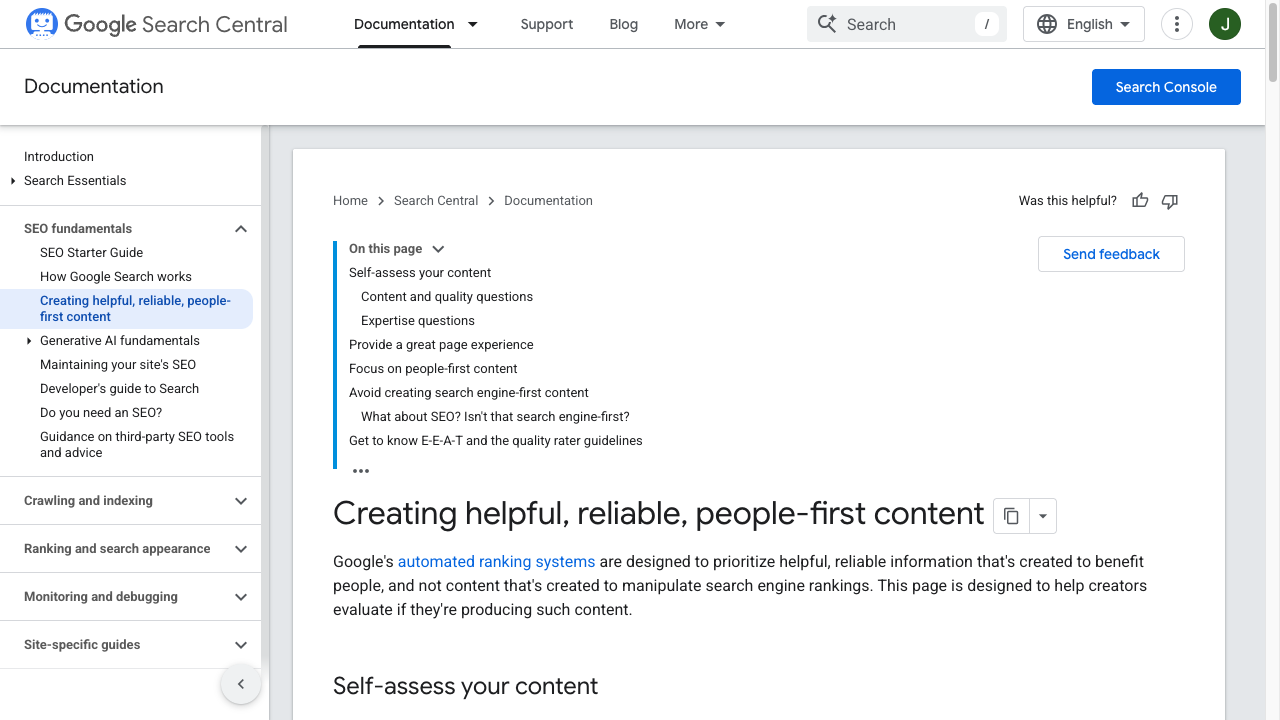
For bulk content, I would simplify it into five questions:
- Does this page leave the reader satisfied?
- Does it show first-hand or expert knowledge where the topic needs it?
- Does it avoid summarizing other pages without adding anything new?
- Is the site publishing this because it helps the audience, not just because it can rank?
- Would a reader trust the author or brand after reading it?
If the answer is weak, the article is not ready.
Gate 5: Use Internal Links Like Editorial Guidance
Internal links should help the reader move to the next useful idea. They should not feel like a list of SEO targets.
If the team is about to turn a workflow live, I would rather they slow down with an autoblogging quality-control checklist than add another internal-link paragraph. Cadence questions belong in a later operational discussion, not as a pile of related articles here.
What does not work is stuffing every adjacent AI writing article into one paragraph. I see this a lot, and it always makes the page feel assembled rather than edited.
How to Scale AI Content Without Wrecking the Site
If I were building a safer AI-assisted content operation, I would use this sequence.
1. Start With a Small Batch
Do not publish 500 articles in the first month.
Start with 10 to 30 pages in one cluster. Track impressions, clicks, engagement, indexing, and conversions. Use those results to improve the brief, the editing checklist, and the internal linking pattern. If the first small batch is mediocre, a bigger batch will usually just make the problem easier to see.
Scaling should come after you prove the workflow, not before.
2. Build Topic Clusters, Not Keyword Dumps
A cluster gives your content a reason to exist together. It also makes internal linking easier because each page has a clear role.
For example, one pillar page might explain AI content production at a high level. Supporting pages could cover editing AI drafts, detecting factual errors, building topical authority, recovering from an algorithm update, and managing publishing velocity.
That is stronger than publishing 80 slight variations of "AI content and SEO."
3. Separate Drafting From Publishing
AI can help with outlines, drafts, summaries, title options, and metadata. But publishing should require human approval.
For serious SEO content, I like a simple status flow:
- brief approved
- draft generated
- editor revised
- claims verified
- internal links checked
- duplicate intent checked
- final publish approved
- performance reviewed
| Workflow stage | AI can help with | Human gate before publishing |
|---|---|---|
| Topic selection | Cluster ideas, query patterns, outline options | Confirm the page has a distinct search intent and business purpose |
| Drafting | First draft, summaries, title variants, metadata options | Add examples, judgment, source checks, and brand-specific perspective |
| Optimization | Internal-link suggestions, schema drafts, SERP angle checks | Remove forced links, verify claims, and check overlap with existing pages |
| Post-publish review | Summarize Search Console patterns and weak-page candidates | Decide whether to improve, consolidate, redirect, noindex, or remove |
That may sound slower, but it prevents the expensive version of speed: publishing content you later have to delete, merge, rewrite, or recover from. I would rather lose a week in review than lose a quarter untangling a bad content expansion.
4. Refresh and Consolidate Instead of Always Creating New Pages
Bulk content teams often default to creating new URLs. That is not always the best move.
Sometimes the smarter play is to improve an existing page, merge overlapping articles, or repurpose strong content into a different format. If one page already has authority, updating it may be safer than creating another page that competes with it. In practice, this is often the least exciting option and the highest-leverage one.
This is especially important after a traffic drop. If a site has hundreds of weak AI pages, trying to polish every single one can become a trap. Consolidation is often cleaner: merge thin pages into stronger guides, redirect where appropriate, and remove pages that never had a real reason to exist.
5. Monitor Quality After Publishing
Publishing is not the end of the workflow.
Check the batch after 2 weeks, 6 weeks, and 3 months. Look for pages that:
- earned impressions but no clicks
- rank for the wrong queries
- overlap with stronger pages
- attract traffic but no engagement
- have outdated claims or weak examples
- do not support the site's topical direction
If a page is weak, improve it. If it overlaps, merge it. If it has no clear value, remove it. A good algorithm update recovery process usually starts with honest content pruning, not more publishing.
When Bulk AI Content Is Actually Useful
Bulk AI content is not always a bad idea. It becomes useful when the job is structured, reviewable, and tied to real data. My bias is to use AI where the inputs are already strong, not where the strategy is vague.
Good use cases include:
- drafting product descriptions from verified product data
- creating first drafts for help documentation
- summarizing long research notes into briefs
- generating metadata options for editor review
- translating already strong content with native review
- refreshing outdated pages with current source material
- producing structured pages from genuinely useful datasets
The common thread is control. The source material is reliable. The format is clear. The review process exists. The page adds something useful.
For example, AI autoblogging can be safer when the workflow includes topic approval, source review, internal linking, metadata, and editorial checks before publishing. The risky version is letting an autoblogging system choose topics, write drafts, publish posts, and interlink pages without human judgment.
A Practical Bulk AI Publishing Checklist
Use this before scaling any AI content workflow.
| Check | Pass condition |
|---|---|
| Search intent | The page answers a specific reader need, not just a keyword |
| Original value | The draft includes examples, data, screenshots, expert notes, or a strong point of view |
| Accuracy | Claims, dates, stats, and product details are verified |
| Differentiation | The page is meaningfully different from nearby pages on the same site |
| Brand voice | The article sounds like the brand, not a generic AI draft |
| Internal links | Links help the reader continue naturally |
| Helpful content | The article would still be useful without search traffic |
| Publishing velocity | The team can review every page properly before it goes live |
| Performance review | The page has a planned review date after publishing |
If a workflow cannot pass this checklist at 50 pages, it will not magically improve at 500. More volume exposes weak systems; it does not fix them.
Final Verdict: Scale the Process, Not the Slop
Bulk AI content is tempting because it makes the hard part look solved. You can create outlines, drafts, titles, summaries, and entire articles in minutes. I understand the appeal. The first time I saw it work, it felt like the production bottleneck had disappeared.
SEO does not reward the existence of pages. It rewards pages that deserve to be found. That is the part bulk workflows keep trying to skip.
The safer path is to scale the repeatable parts of production and keep humans on the parts that decide quality: topic selection, examples, claims, voice, structure, and final approval. If you want the operational version of that argument, I laid it out in the bulk AI content generation guide.
So yes, use AI. I would. Use it to move faster. Use it to organize research, create first drafts, and cut repetitive work.
Just do not confuse faster publishing with better publishing. That is how bulk content generation stops being a growth strategy and starts becoming the reason a site disappears from Google.