
Best AI Tools With Ghost Integration: Direct Publishing Options for Ghost CMS

Yi
SEO Expert & AI Consultant

If you use Ghost, the best AI tool is not just the one that writes a decent draft. It is the one that can get an optimized article into Ghost without turning publishing into a copy-paste chore.
That is the real search intent here. Ghost already gives you a clean publishing system. The missing piece is usually a content workflow that handles research, drafting, SEO, editing, and publishing without forcing you through five disconnected apps.
Here is the practical answer:
| Tool | Best for | Ghost integration depth |
|---|---|---|
| Junia AI | SEO articles, keyword-led blog posts, and one-click Ghost publishing | Direct Ghost blog connection and publishing workflow |
| AirOps | Content operations teams that want repeatable AI workflows | Ghost publishing through a configured workflow |
| Cuppa | Simple AI article generation with Ghost export/publishing support | Ghost publishing support for generated content |
| Jasper | Brand copy and team collaboration | Indirect workflow through Zapier/API automation, not the cleanest direct Ghost setup |
For most Ghost publishers, I would start with Junia AI if SEO content is the main job. AirOps is better if you are building a larger content operations system. Cuppa is worth testing if you want a simpler writer-to-Ghost workflow. Jasper can still help with writing, but I would not choose it primarily for Ghost publishing.
What Counts as a Real Ghost Integration?
A real Ghost integration should do more than generate text and leave you to paste it manually.
Ghost supports integrations through its official integration system and Admin API. The Ghost custom integrations documentation explains how external tools can connect to a Ghost site, and the Ghost Admin API is what allows tools to create, update, and manage content programmatically.
Ghost's own publishing docs are the useful test here. If a tool cannot preserve post settings, tags, metadata, and the editor structure you see in Ghost, you will still be pasting and fixing by hand.
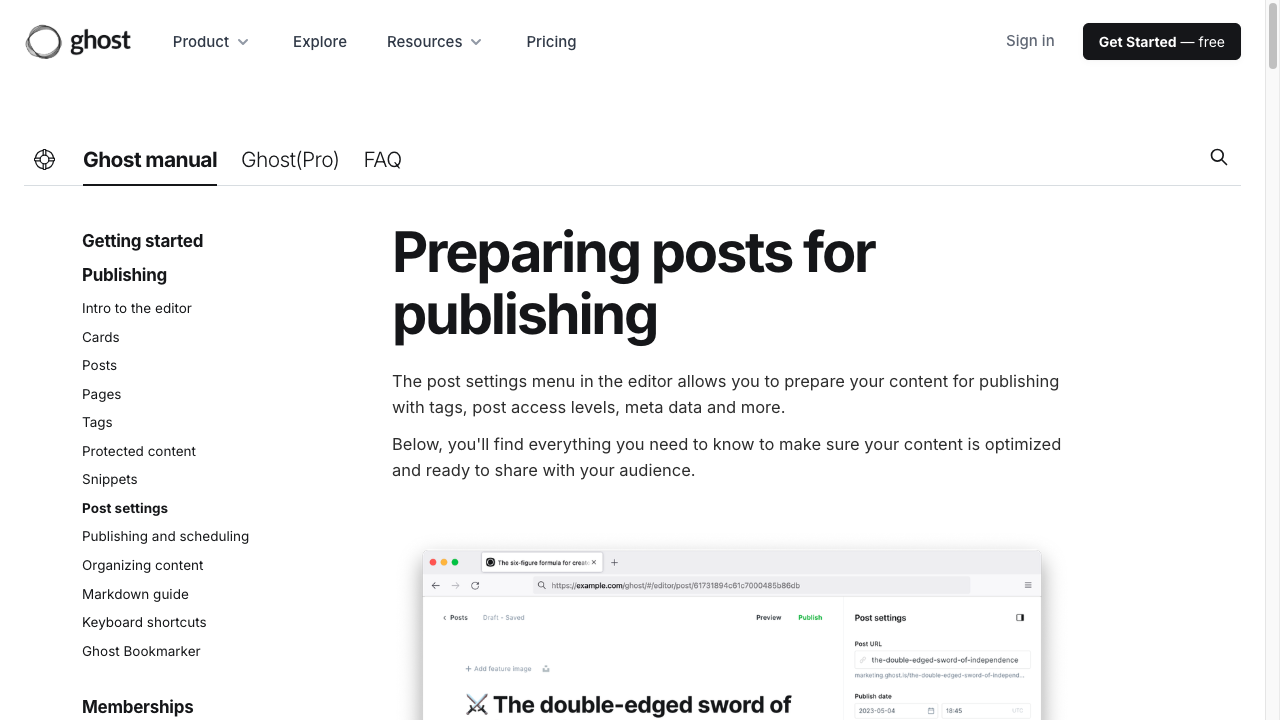
For an AI writing workflow, that usually means the tool should help with at least one of these:
- Connecting to your Ghost site through an integration or API key.
- Sending a finished draft into Ghost as a post.
- Preserving structure such as headings, links, lists, and metadata.
- Supporting SEO fields such as titles, descriptions, slugs, or keyword guidance.
- Reducing manual formatting work after import.
This matters because a weak integration only moves the bottleneck. If an AI tool writes the article but breaks headings, strips links, or forces manual formatting inside Ghost, it is not really saving much time.
1. Junia AI
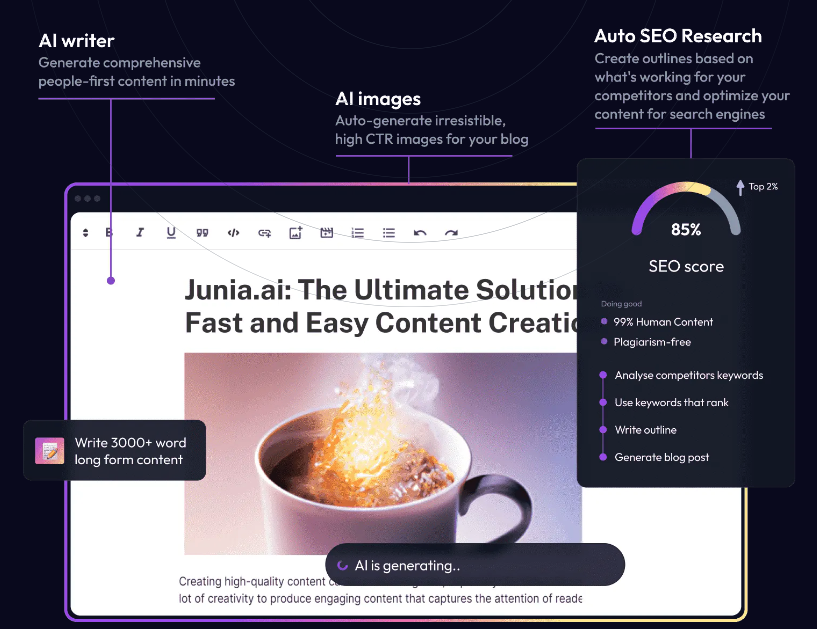
Junia AI is the strongest fit if your Ghost workflow is mainly about publishing SEO articles. It combines AI writing, keyword guidance, optimization, and Ghost publishing in one place, which is exactly what many Ghost users are trying to avoid building manually.
Junia AI is especially useful when you want to move from keyword to article to published Ghost post without switching between a separate keyword tool, AI writer, SEO checklist, and CMS editor.
Why Junia Works Well With Ghost
Junia AI has a documented Ghost connection workflow, so it is not just a generic AI writing tool that happens to produce text. The integration is meant for publishing content directly to a Ghost blog after setup.
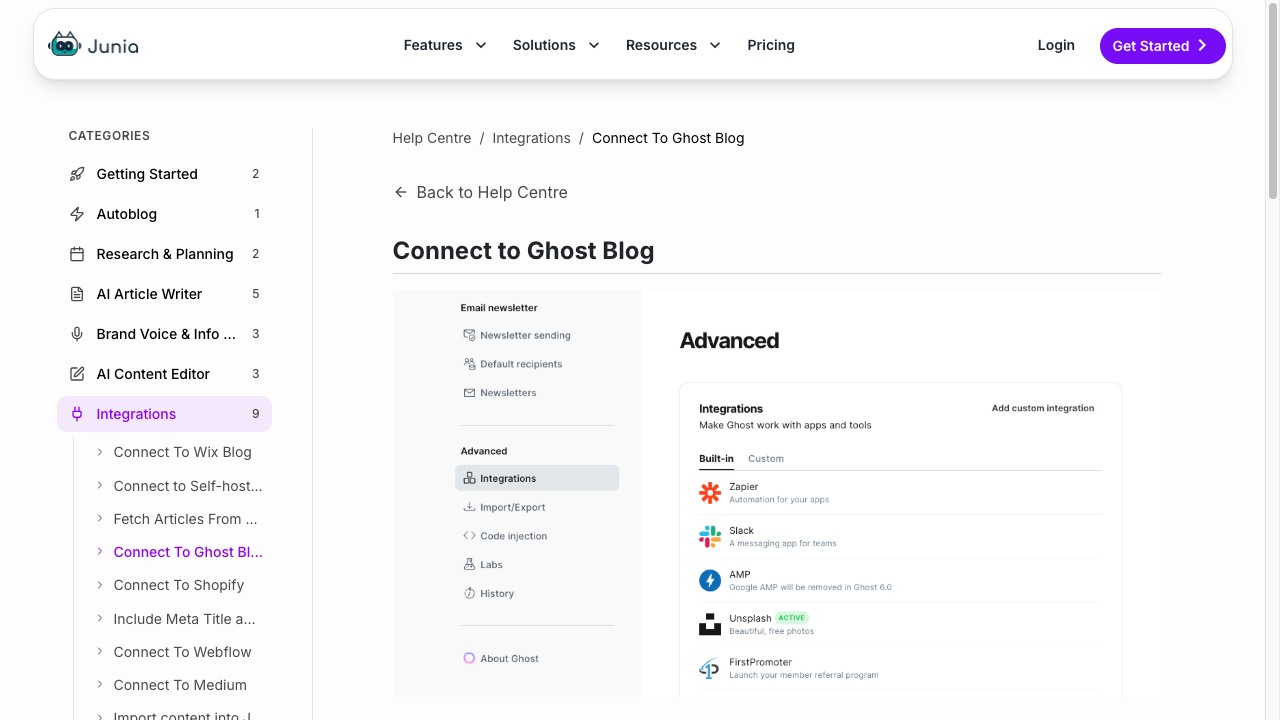
That makes it useful for:
- Solo publishers who want to ship articles faster.
- SEO teams that need a repeatable blog workflow.
- Ghost site owners who do not want WordPress-style plugin sprawl.
- Agencies managing content for Ghost-based client sites.
The biggest advantage is workflow fit. Ghost is often chosen because it is focused and lightweight. Junia AI matches that by handling the article production layer before the post reaches Ghost.
Best Junia Features for Ghost Users
The most useful features are the ones that reduce the work around the article, not just the paragraph generation.
| Feature | Why it matters for Ghost publishing |
|---|---|
| AI article generation | Helps create long-form drafts from topics, keywords, or briefs |
| SEO guidance | Supports keyword targeting, headings, and content structure before publishing |
| Ghost publishing | Reduces manual copying and formatting inside Ghost |
| Blog workflow tools | Helps move from idea to draft to optimized post |
| Bulk content options | Useful if you publish regularly or manage multiple content briefs |
If you are building a larger SEO workflow, Junia can cover more than Ghost publishing. Use the AI article writer when the goal is a single optimized draft, or bulk content creation when you need many related pages from one plan.
For repurposing, URL to article is useful when an existing page or source needs to become a fresh draft. For hands-off publishing, AI autoblogging fits workflows where the content pipeline needs to run on a schedule.
Where Junia AI Fits Best
Use Junia AI when the final goal is a polished, search-focused Ghost article.
It is a better fit than a general chatbot when you need:
- Keyword-led article planning.
- SEO-friendly structure.
- Long-form blog generation.
- Internal links and article polish.
- A publishing path into Ghost.
Choose the comparison based on how much control you need. AI article writers are better when an editor still wants to shape each piece, while AI autoblogging tools make more sense when the publishing workflow is intentionally more automated.
2. AirOps
AirOps is not just an AI writer. It is closer to a workflow builder for content operations.
That makes it useful for teams that want repeatable processes around research, outlines, drafting, optimization, approval, and publishing. If you have a simple Ghost blog and publish once a week, it may be more than you need. If you have many templates, briefs, writers, or programmatic pages, it becomes more interesting.
AirOps has documentation for publishing to Ghost as part of an automated workflow, which makes it a stronger Ghost option than tools that only generate copy.
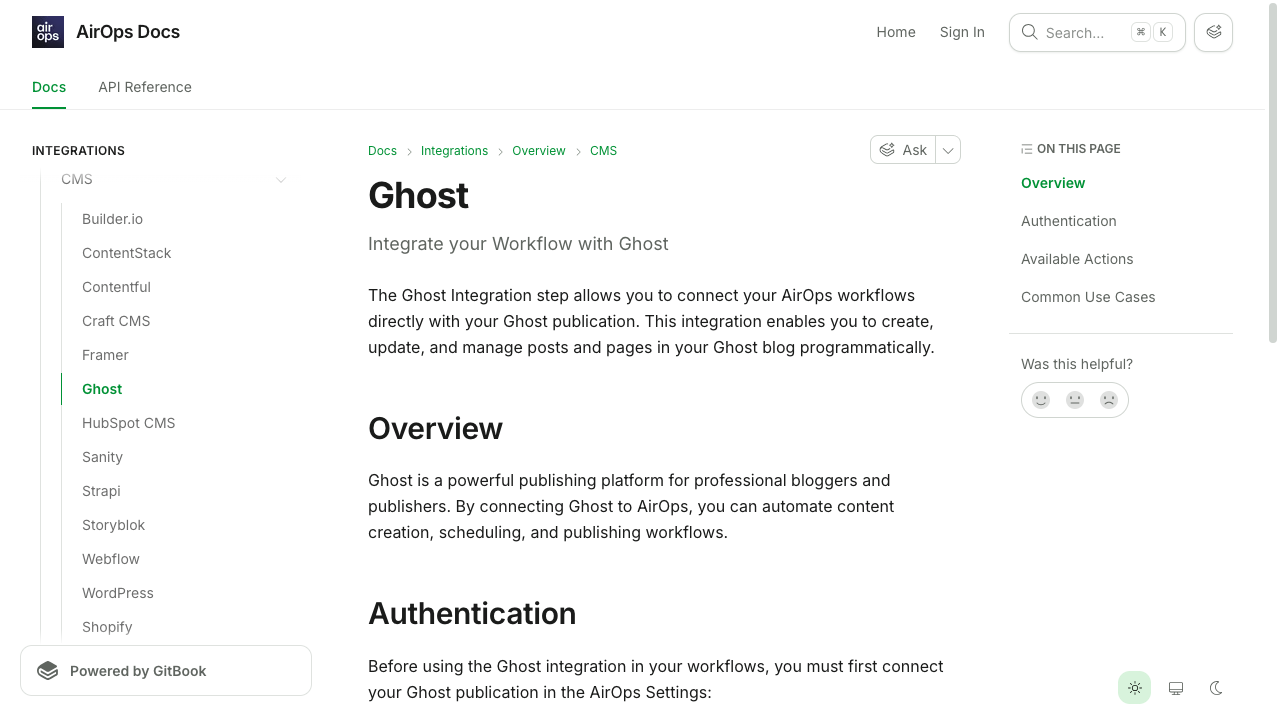
Why AirOps Works Well With Ghost
AirOps is best when you want to design the content workflow, not just generate one post.
For example, a team could build a workflow like this:
- Add a keyword or content brief.
- Generate a search-focused outline.
- Draft the article.
- Apply brand or SEO checks.
- Send the approved draft into Ghost.
That kind of workflow is useful if content has to pass through the same steps every time. It is also helpful for agencies or internal teams where consistency matters.
Where AirOps Fits Best
Use AirOps when your Ghost publishing process is part of a larger operation.
It is strongest for:
- Repeatable content templates.
- Multi-step AI workflows.
- Programmatic or scaled SEO content.
- Team processes with approvals.
- Content systems where the prompt chain matters.
If you only want a clean AI blog writer, AirOps may feel heavy. If you want a system that turns content production into a controlled workflow, it is one of the more serious options.
3. Cuppa
Cuppa is a simpler option for people who want AI-generated articles and Ghost publishing support without building a full content operations stack.
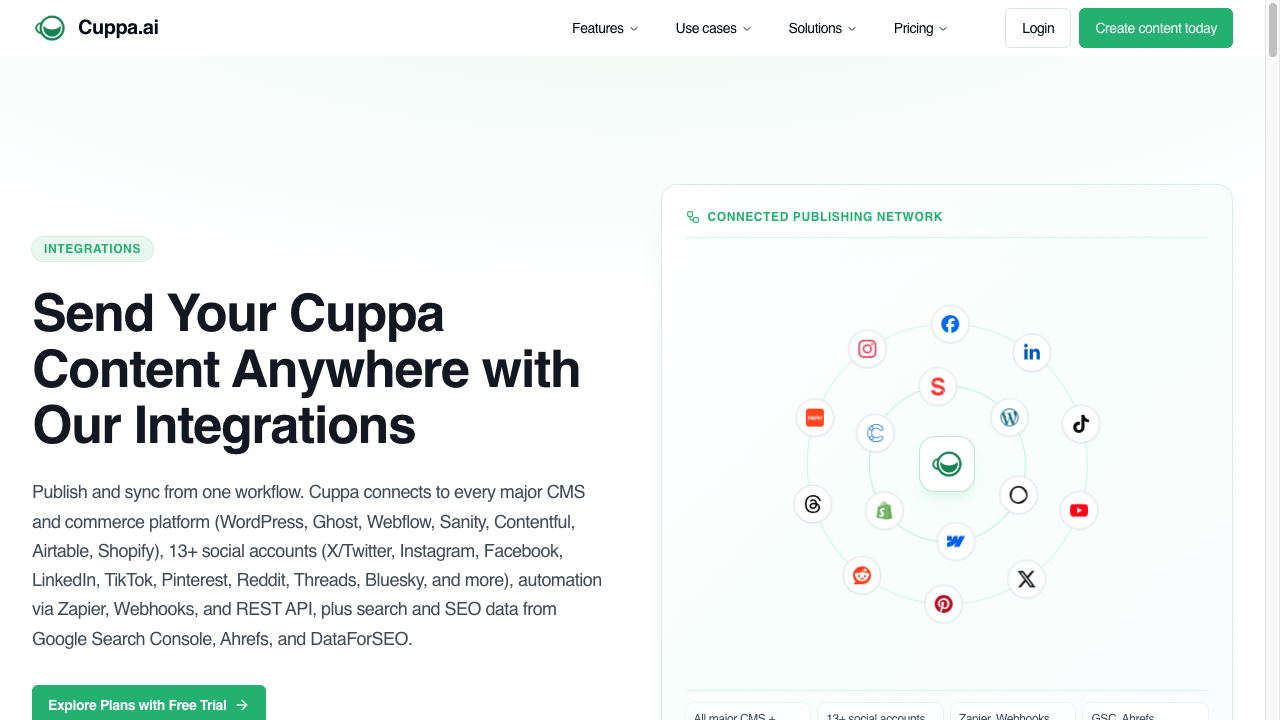
It is worth considering if your main workflow is straightforward:
- Generate an article.
- Edit it.
- Publish or export it to Ghost.
That simplicity can be a feature. Not every Ghost publisher needs advanced workflow automation, multiple approvals, or elaborate prompt chains.
Where Cuppa Fits Best
Cuppa is a practical fit for:
- Solo bloggers.
- Small content sites.
- Simple AI-assisted publishing workflows.
- Users who want a lighter alternative to bigger content platforms.
It is not the first tool I would choose for deep SEO planning or large content operations. But if the goal is to get AI-assisted posts into Ghost with less friction, it belongs on the shortlist.
What About Jasper?
Jasper is still a strong AI writing platform for brand copy, campaign content, and team collaboration. The problem is Ghost integration.
A custom Zapier workflow can use Jasper to generate copy and Ghost as the publishing destination. Follow Jasper’s Zapier setup and Ghost’s Zapier integration guide. Jasper’s connector requires its Business plan and an API key; you also need to configure the Ghost action and map the content fields.
Zapier is not the same as a native Ghost integration. A Zap can move text into Ghost. It does not automatically preserve headings, cards, excerpts, tags, and SEO fields the way a direct Admin API connection should. I would only build that extra layer if the team already lives in Jasper and Ghost is just one of several destinations.
But it is not the same as choosing a tool built around Ghost publishing.
Use Jasper if:
- Your team already writes in Jasper.
- Brand voice and collaboration matter more than CMS publishing.
- You are comfortable building a Zapier-based workflow.
- Ghost is only one destination among many.
Do not choose Jasper mainly because you want the smoothest Ghost publishing experience. For that, Junia, AirOps, or Cuppa are more aligned with the job.
How to Choose the Right AI Tool for Ghost
The right choice depends on the bottleneck in your workflow.
| If your problem is... | Choose |
|---|---|
| You need SEO articles published into Ghost with minimal friction | Junia AI |
| You need repeatable AI workflows for a team or agency | AirOps |
| You want a simple AI writer with Ghost publishing support | Cuppa |
| You already use Jasper and want to connect it through automation | Jasper + Zapier |
| You only need occasional brainstorming | ChatGPT, Claude, or Gemini outside Ghost |
The mistake is choosing based only on writing quality. Most modern AI tools can draft a reasonable article. The real difference is what happens after the draft exists.
For Ghost users, the best tool should make the whole path easier:
- Topic or keyword.
- Outline.
- Draft.
- Edit.
- Optimize.
- Publish.
If the tool only helps with one step and creates cleanup work in the next step, it may not be the best fit.
A Simple Ghost AI Publishing Workflow
Here is the workflow I would use for most Ghost blogs:
- Keyword and brief
- AI draft
- Human edit
- SEO pass
- Publish to Ghost
- Live QA
View diagram source
flowchart LR
  A[Keyword and brief] --> B[AI draft]
  B --> C[Human edit]
  C --> D[SEO pass]
  D --> E[Publish to Ghost]
E --> F[Live QA]- Choose the keyword or topic. Start with the reader's intent, not just the phrase you want to rank for.
- Build a short brief. Include the angle, audience, must-cover points, internal links, and examples.
- Generate the draft. Use Junia AI, AirOps, Cuppa, or another AI tool to create the first version.
- Edit for usefulness. Cut generic sections, add examples, check facts, and make the article sound like it came from someone who understands the topic.
- Optimize before publishing. Review title, meta description, headings, links, and image alt text.
- Publish to Ghost. Use the direct integration or automation workflow instead of manually reformatting the article.
- Review after publishing. Check the live post for formatting, broken links, image display, and metadata.
Ghost's official publishing docs are the right reference for that last mile, especially post settings, scheduling, and metadata. If you want the editor walkthrough from Ghost itself, start with their publishing and scheduling help.
Ghost's own product walkthrough is the right video for this section, not another "best CMS" roundup:
Ghost.org complete tutorial: start a blog, write a post, and publish
That last step matters. Even a good integration should be checked after publishing because small formatting issues can slip through. A missing image, broken internal link, or incorrectly imported heading can create problems that are easy to miss during the drafting stage.
The workflow itself is fairly simple. Most of the complexity comes from everything that happens before the article reaches Ghost. Research, outlining, optimization, and publishing all need to work together if the goal is consistent organic traffic. That's one reason the choice of CMS still matters, especially when comparing different CMS platforms for SEO and how they handle content structure, metadata, and long-term site growth.
The optimization stage is also where many teams spend most of their time. Keyword targeting, content gaps, internal linking, and on-page improvements usually have a bigger impact on rankings than the publishing step itself. To make that process more efficient, many publishers rely on AI SEO tools during research, optimization, and content reviews before an article goes live.
Common Mistakes to Avoid
The first mistake is assuming every AI writer integrates with Ghost just because it can create blog content. Blog generation and Ghost publishing are different jobs.
The second mistake is overvaluing one-click publishing. Fast publishing is helpful, but not if the article still needs serious editing, fact-checking, and SEO cleanup.
The third mistake is ignoring formatting. Ghost posts often include headings, links, images, cards, excerpts, tags, and metadata. A good workflow should preserve as much of that structure as possible.
The fourth mistake is treating AI output as finished content. AI can speed up drafting, but publishable Ghost content still needs a human pass for accuracy, voice, examples, and reader value. The bottleneck for most content teams is not getting words onto the page; it's maintaining quality as publishing volume increases. That's why many teams evaluate dedicated AI blog generators separately from their CMS, since content creation and content publishing solve different problems.
The fifth mistake is assuming that better tools automatically produce better content. In practice, results depend far more on the quality of the brief, instructions, and editorial process. If drafts consistently sound generic or repetitive, the problem is often how the tool is being used rather than the tool itself. Learning how to use an AI text generator effectively can improve output quality far more than adding another layer of automation.
Final Recommendation
If you want the most direct answer, start with Junia AI for Ghost CMS.
It is the best fit when you care about SEO content, article structure, and publishing into Ghost without stitching together too many tools. AirOps is the better choice for advanced content operations. Cuppa is the simpler alternative if you want a lighter AI writer with Ghost support.
Jasper is still worth using if your team already relies on it for brand content, but I would treat it as an indirect Ghost option rather than a dedicated Ghost publishing tool.
The best AI tool for Ghost is the one that removes friction without removing editorial control. I would draft faster, publish cleaner, and still review the live post like a publisher.