
What Is an AI SEO Agent? How It Works and When to Use One

Thu
AI SEO Specialist, Full Stack Developer

An AI SEO agent is software that can plan, run, and improve parts of an SEO workflow with less manual prompting than a normal AI tool.
That does not mean you press one button and rankings appear. A good agent still needs goals, source material, review rules, and human judgment. But instead of asking a chatbot for one keyword list, then another prompt for a brief, then another prompt for internal links, an agent can connect those steps into one workflow.
In practical terms, an SEO agent helps you move from "we need more search traffic" to a clearer operating system: research the opportunity, decide the page type, create or improve the content, add internal links, and monitor what changed.
What an AI SEO Agent Actually Does
Most SEO work is not one task. It is a chain of decisions.
You choose a topic, check intent, compare competitors, build a brief, write the page, optimize the structure, add links, publish, then revisit the page once data comes in.
An AI SEO agent helps coordinate that chain. It can:
- find keyword and topic opportunities
- group related queries into a content plan
- generate briefs for writers or editors
- draft sections from approved inputs
- suggest metadata, headings, FAQs, and schema ideas
- recommend internal links between related pages
- flag thin sections, missing subtopics, and stale pages
- help prioritize refreshes based on impact
That is the main difference between a simple AI prompt and an agentic workflow. The agent is not just answering a question. It is trying to complete a repeatable SEO job.
How AI SEO Agents Work
Most AI SEO agents work from three inputs: your site, the search market, and your goal.
Your site input might include existing URLs, content, internal links, product pages, brand voice, and Search Console data. The search input might include keywords, SERP patterns, competitor pages, related questions, and ranking gaps. The goal tells the agent what to optimize for, such as new content creation, content refreshes, product-led SEO, or internal linking.
From there, the agent breaks the work into smaller steps.
For example, a content workflow might look like this:
- Analyze the target keyword and search intent.
- Identify whether the page should be a guide, comparison, list, template, or landing page.
- Build a brief with required sections, sources, examples, and internal links.
- Draft or improve the content.
- Check for missing subtopics, weak headings, and repetitive copy.
- Add internal links to relevant pages.
- Create metadata and FAQs.
- Send the final draft for human review.
That is why a component like an SEO content brief generator is so important. Briefs turn messy research into instructions the rest of the workflow can follow.
AI SEO Agent vs Regular AI SEO Tool
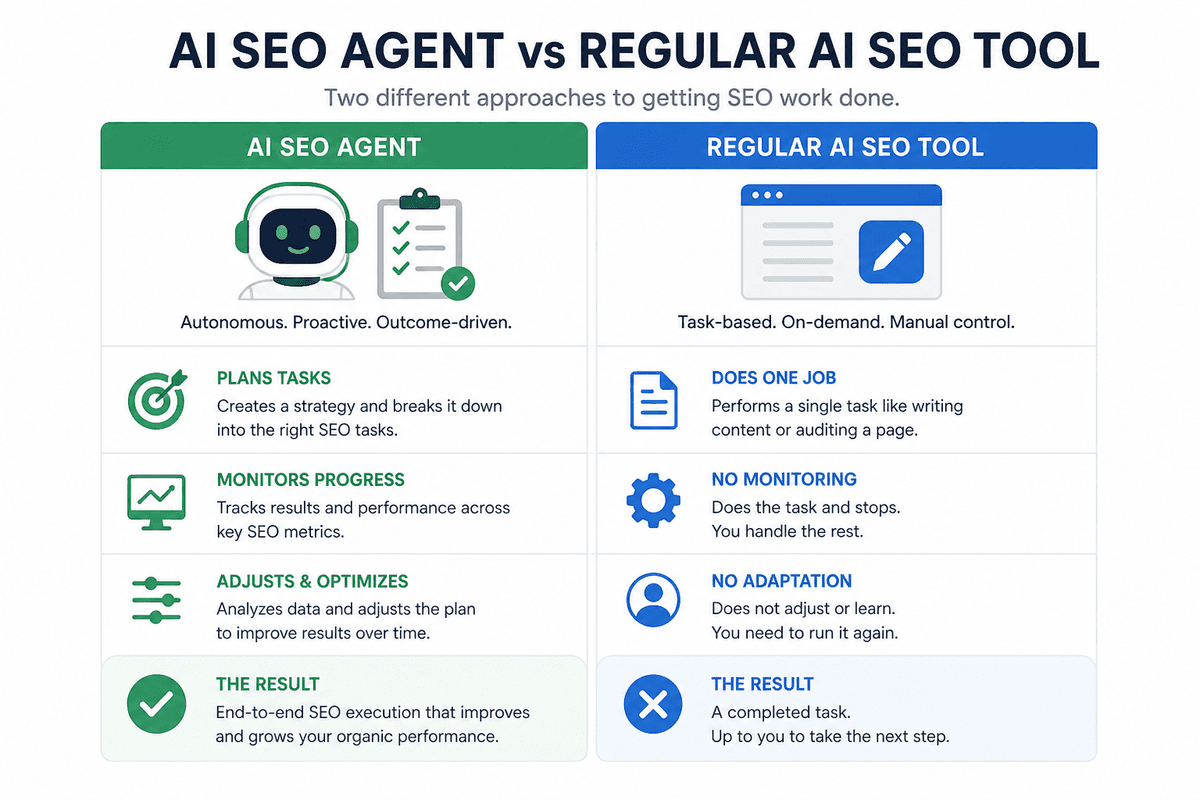
| AI SEO agent | Regular AI SEO tool |
|---|---|
| Plans multi-step work | Does one job (write, audit, score) |
| Monitors and adjusts | Waits for the next click |
| Needs guardrails + review | Clearer single-output scope |
A regular AI SEO tool usually solves one part of the job. It might generate keywords, score content, write a meta description, or suggest internal links.
An AI SEO agent connects several of those jobs into a workflow.
| Capability | AI SEO tool | AI SEO agent |
|---|---|---|
| Scope | One task or feature | Multi-step workflow |
| Input | A prompt, keyword, URL, or document | Site context, goals, pages, and rules |
| Output | A list, score, draft, or recommendation | A completed workflow or prioritized action plan |
| Best for | Specific SEO tasks | Coordinated SEO execution |
| Human role | Use the output | Review decisions and approve changes |
Neither is automatically better. If you only need keyword ideas, a focused tool is enough. If you need to run the same SEO process across dozens of pages, an agent is usually more useful.
When to Use an AI SEO Agent
Use an agent when…
- The workflow spans research → brief → draft → publish checks
- You can define success metrics and bans
- A human still reviews money/reputation pages
Skip an agent when…
- You only need one rewrite
- Inputs are messy and undefined
- Nobody will review the output
Use an AI SEO agent when the work has repeatable steps and clear quality rules.
For example, it can be useful when you are:
- building a new topic cluster
- refreshing a large group of old articles
- creating SEO briefs for a content team
- finding internal link opportunities after publishing
- scaling content for SaaS, ecommerce, or agency clients
- turning competitor research into a content roadmap
- improving pages that are ranking but not converting
The best use cases are not vague tasks like "make my SEO better." They are specific workflows like "find five missing pages in this AI SEO cluster, write briefs for each one, and suggest internal links from existing articles."
When Not to Use One
Do not use an AI SEO agent as a substitute for strategy.
If your product positioning is unclear, your site has no real expertise, or your pages do not answer a reader's actual problem, automation will only scale the weakness.
You should also be careful with fully automated publishing. Search engines do not reward content just because it is long or technically optimized. The page still needs to be useful, accurate, and different enough to deserve attention.
So keep humans involved in the parts where judgment matters:
- choosing which topics are worth publishing
- validating facts and claims
- reviewing product positioning
- checking examples and screenshots
- approving internal links and CTAs
- deciding whether a page should exist at all
What a Good AI SEO Agent Should Include
A useful agent should not just generate text. It should help you make better SEO decisions.
Look for these capabilities:
- Keyword and intent analysis: It should understand what the searcher wants, not just produce keyword variations.
- Brief creation: It should turn research into a structured plan before drafting.
- Content optimization: It should improve headings, coverage, metadata, FAQs, and clarity.
- Internal linking: It should recommend links based on topical relevance, not just matching words.
- Workflow memory: It should use your brand, audience, products, and past content as context.
- Human review points: It should make approval easy before anything important goes live.
The goal is not to remove the editor. The goal is to remove repetitive SEO busywork so the editor can focus on quality.
Final Takeaway
An AI SEO agent is best understood as an SEO workflow operator.
It can research, plan, draft, optimize, and connect content faster than a person doing every step manually. But it still needs direction. The strongest setup is not "AI does SEO for me." It is "AI handles the repeatable parts while humans make the strategic calls."
Use an AI SEO agent when you have clear goals, enough site context, and a workflow worth repeating. Keep human review in the loop, and it can become a practical way to scale SEO without turning your site into a pile of generic pages.