
SaaS SEO Checklist: A 9-Point Audit for Rankings, Demos, and Pipeline

Thu
AI SEO Specialist, Full Stack Developer

A SaaS SEO checklist should not stop at keywords, title tags, and blog posts. In SaaS, SEO has to support the whole buying journey: problem searches, comparison searches, integration searches, pricing objections, demo pages, trial pages, and expansion content after someone becomes a customer.
That is why I would treat this as a revenue audit, not just a publishing checklist. The question is not "did we optimize the page?" The better question is "can the right buyer find, trust, and act on this page?"
TL;DR: The SaaS SEO Checklist
If you only have an hour, audit these nine areas first:
| Checklist item | Pass signal |
|---|---|
| Intent map | Keywords tied to demos/signups |
| Technical | Key templates indexable |
| Internal links | Revenue pages get crawl paths |
| Content | SERP-competitive + product-aware |
SaaS SEO isn’t blog volume. It’s pipeline-aware search.
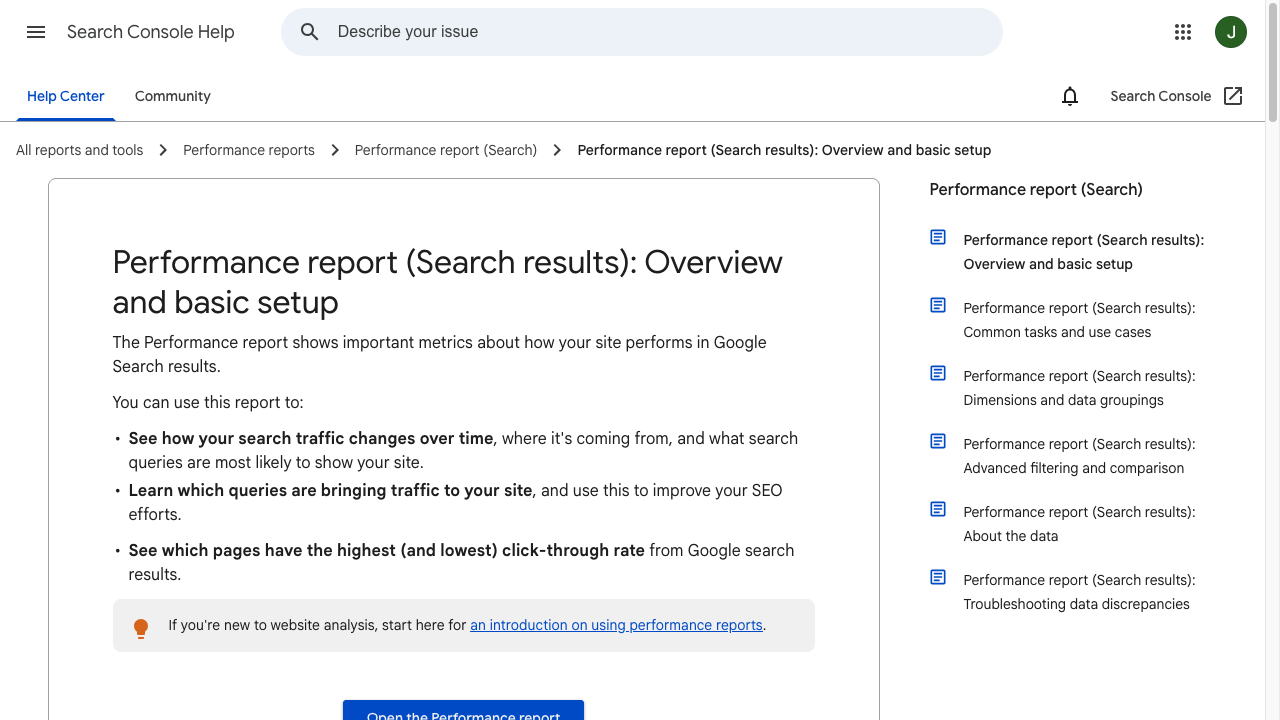
Performance reports in Search Console - Google Search Console Training
| Step | Audit area | What to check first |
|---|---|---|
| 1 | Intent and funnel mapping | Each important keyword has the right page type and CTA |
| 2 | Content quality | The page answers the query quickly and beats the current SERP |
| 3 | Technical SEO | Strategic pages are crawlable, indexable, fast, and canonicalized |
| 4 | Internal links | Educational pages point naturally toward product, solution, and conversion pages |
| 5 | Landing pages | Solution, feature, pricing, and demo pages match both search intent and buyer objections |
| 6 | Authority | Link building supports the pages that need ranking help, not just the homepage |
| 7 | Competitor gaps | You know which topics, formats, and proof points competitors cover better |
| 8 | Refreshes | Decaying, overlapping, or outdated content has a clear update, merge, or prune decision |
| 9 | Measurement | SEO reporting connects rankings and clicks to trials, demos, pipeline, or assisted revenue |
For most SaaS teams, I would run the full audit quarterly and review technical issues, high-value pages, and conversion data monthly.
Why SaaS SEO Needs a Different Checklist
Generic SEO checklists often treat every page like a blog post. SaaS sites do not work that way, and I have seen plenty of audits go sideways because they ignore that distinction.
A SaaS site can include homepage copy, feature pages, use-case pages, comparison pages, alternative pages, integration pages, pricing pages, product-led templates, help docs, partner pages, and long-form educational content. Each page has a different job.
That is the first thing the checklist needs to protect:
| Funnel stage | Searcher intent | Page types to audit |
|---|---|---|
| Problem aware | "how to automate content briefs", "why organic traffic dropped" | Guides, templates, educational blog posts |
| Solution aware | "AI SEO tools", "SaaS technical SEO" | Tool pages, solution pages, category pages |
| Vendor aware | "Junia alternatives", "best AI content platform" | Alternative pages, comparison pages, case studies |
| Conversion ready | "pricing", "demo", "integration with..." | Pricing, demo, signup, integration, security pages |
| Expansion | "how to scale multilingual SEO", "internal linking workflow" | Help docs, playbooks, customer education |
This matters even more now because search is sending fewer easy clicks. SparkToro and Datos reported that for every 1,000 Google searches in the United States in 2024, only 360 clicks went to the open web, and just under 60% of U.S. mobile web and desktop searches ended without a click. Pew Research Center also found that when Google AI summaries appeared, users clicked a traditional result in 8% of visits, compared with 15% when no AI summary appeared.
The practical takeaway is simple: SaaS pages need to rank, earn the click when one exists, and be clear enough to be cited, summarized, shared, or remembered when the click does not happen. That is a harder standard than "publish more content."
Search and AI Data to Keep in Mind
| Search signal | Recent finding | What it changes in the checklist |
|---|---|---|
| Open-web clicks | SparkToro/Datos reported 360 open-web clicks per 1,000 U.S. Google searches in 2024 | Titles, intros, summaries, and brand recall matter more |
| Zero-click behavior | SparkToro/Datos reported that just under 60% of U.S. mobile web and desktop searches ended without a click | Pages should give useful answers early, not hide them below a long setup |
| AI summaries | Pew found traditional result clicks dropped from 15% to 8% when an AI summary appeared | Use concise definitions, source-backed claims, and quotable sections |
| AI summary links | Pew found users clicked a link inside an AI summary in 1% of visits where a summary appeared | Do not measure SEO only by last-click organic sessions |
| AI Search eligibility | Google says the same SEO fundamentals apply to AI Overviews and AI Mode, with no special extra requirements beyond being eligible for Search snippets | Focus on crawlability, helpful content, clear structure, and strong page quality |
I would not overreact to AI Search with gimmicks. The better move is to make each important page easier to crawl, easier to quote, and easier for a buyer to understand.
1. Map Keywords to SaaS Intent
Start by checking whether every important keyword has the right page behind it. This is the part I would slow down for, because a bad page-to-query match can waste months of otherwise decent SEO work.
This is where many SaaS SEO programs quietly lose momentum. A blog post tries to rank for a product-intent query. A feature page targets a broad informational keyword. A comparison page reads like generic thought leadership. The page may be optimized, but it is optimized for the wrong job.
Use this audit:
| Check | What good looks like |
|---|---|
| Primary keyword | One clear primary query per page, not five competing targets |
| Search intent | The page format matches what the SERP rewards: guide, checklist, tool page, comparison, template, or landing page |
| Funnel stage | The CTA matches the reader's awareness level |
| SERP format | You account for videos, snippets, forums, AI summaries, tools, and comparison lists |
| Cannibalization | One page is the best answer for the main query |
If two pages overlap, do not just add more keywords. Decide which page should win, then update the title, headings, internal links, and content depth around that decision. In my experience, this is often where SaaS teams need an editorial call more than another keyword export.
For new content, create the brief before drafting. A SEO content brief generator can help turn the target query, competing pages, entities, headings, and internal links into a cleaner plan before a writer starts filling the page.
2. Check Content Quality Against the Current SERP
Google's guidance on helpful content is still the right baseline: content should be useful, reliable, and made for people rather than mainly to attract search visits. Google also recommends self-assessing whether a page adds original value compared with other results.
For SaaS, I would make that more concrete. The page has to help a buyer make progress, not merely prove that the brand knows the vocabulary:
| Content question | Fix if the answer is no |
|---|---|
| Does the page solve the query quickly? | Move the answer, checklist, template, or recommendation higher |
| Does it show product or domain expertise? | Add workflow details, screenshots, examples, limitations, or decision criteria |
| Does it support important claims? | Add sources, data, tests, customer examples, or clear reasoning |
| Does it beat the structure of ranking pages? | Reorder sections around the reader's task |
| Does it guide the next step? | Add a relevant CTA or internal link only where it helps the reader continue |
The common SaaS mistake is publishing broad "what is..." articles for queries that clearly want a checklist, workflow, or comparison. I am usually skeptical of these pages when they spend the first several sections defining the obvious. If someone searches for a SaaS SEO checklist, they want something they can use during an audit. Give them the checklist early, then explain how to run it well.
If an existing article is close but too thin, run it through a focused SEO improver pass and check whether the output adds real examples, sharper intent matching, and stronger structure. Do not accept a rewrite that only adds length.
3. Audit Technical SEO and Indexation
Technical SEO protects every other SEO investment. A strong guide still struggles if Google cannot crawl it cleanly, users abandon it on mobile, or programmatic templates create duplicate versions of the same page. It is not the most glamorous part of SaaS SEO, but it is often the fastest way to stop wasting content effort.
Start with these checks:
| Area | What to review | Tool or report |
|---|---|---|
| Indexation | Important pages are indexed; thin or duplicate pages are not bloating the index | Google Search Console Pages report |
| Crawl paths | Key pages are reachable through navigation, hubs, and internal links | Crawl tool, internal link report |
| Canonicals | Duplicate or filtered URLs point to the preferred version | Page source, crawler |
| Sitemaps | Strategic URLs are included and stale URLs are removed | XML sitemap, Search Console |
| JavaScript rendering | Main content and links are visible after rendering | URL Inspection, rendered HTML |
| Page experience | Priority pages meet Core Web Vitals where possible | Search Console, PageSpeed Insights |
Google's Core Web Vitals benchmarks are a useful technical shorthand:
| Metric | What it measures | Good benchmark |
|---|---|---|
| Largest Contentful Paint | Loading performance | 2.5 seconds or faster |
| Interaction to Next Paint | Responsiveness | Under 200 milliseconds |
| Cumulative Layout Shift | Visual stability | Less than 0.1 |
For a SaaS site, prioritize pages closest to revenue first: homepage, pricing, demo, product pages, comparison pages, and high-traffic guides. I would rather fix crawl and speed issues on ten strategic pages than produce a beautiful audit of hundreds of URLs no buyer ever sees. A deeper SaaS technical SEO audit is worth doing when the site has lots of templates, JavaScript rendering, filtered pages, or international versions.
4. Strengthen Internal Links Around Revenue Pages
Internal linking is easy to postpone because it does not feel as urgent as publishing new content. But weak internal linking creates two problems: search engines may not understand which pages matter most, and readers may never move from educational content to product pages. I treat it as distribution inside the site, not housekeeping.
Google's SEO Starter Guide says descriptive link text helps users and Google understand the linked page before visiting it. For SaaS, that means anchor text should describe the next useful step, not repeat an exact-match keyword just because it is in a spreadsheet.
Run this internal link audit:
| Check | What to do |
|---|---|
| Orphan pages | Add links from relevant hubs, articles, and navigation paths |
| Money pages | Link to solution, feature, demo, and pricing pages from related informational pages |
| Anchor text | Use natural, descriptive anchors instead of repeated exact-match anchors |
| Link depth | Keep strategic pages within a few clicks of strong hubs |
| Old posts | Add links from pages that already have traffic, links, and topical relevance |
For example, a post about SaaS SEO mistakes should not end with a pile of related links. It should explain the mistake, then point to the next practical fix. If the issue is weak crawlability, send readers to a technical audit. If the issue is disconnected blog content, a tool for AI internal linking makes more sense than another broad strategy article.
5. Optimize SaaS Landing Pages for Search and Conversion
Landing pages need a different audit than blog posts. They have to answer the keyword, explain the product, handle objections, and make the next action obvious. This is where I tend to be strict: clever positioning is less useful than a page that says who it is for, what it does, and why the buyer should believe it.
Use this flow for solution, feature, and use-case pages:
- Search intent and page promise
- Who the page is for
- Problem and workflow
- Product capability
- Proof: screenshots, examples, integrations, data
- Objections: pricing, setup, security, limitations
- CTA: demo, trial, signup, template
View diagram source
flowchart TD
  A[Search intent and page promise] --> B[Who the page is for]
  B --> C[Problem and workflow]
  C --> D[Product capability]
  D --> E[Proof: screenshots, examples, integrations, data]
  E --> F[Objections: pricing, setup, security, limitations]
  F --> G[CTA: demo, trial, signup, template]
Then check each page against this table:
| Landing page element | What to look for |
|---|---|
| H1 | Matches the query and the product promise |
| Above the fold | Explains what the product does without vague SaaS language |
| Proof | Includes screenshots, examples, customers, integrations, data, or use cases |
| Comparison | Makes tradeoffs clear when buyers are evaluating alternatives |
| CTA | Fits intent: demo for sales-led pages, trial/signup for product-led pages |
| Metadata | Title and description are written for clicks, not just keywords |
The CTA should change with intent. A visitor searching "SaaS SEO checklist" may want a tactical audit, template, or workflow. A visitor searching for an AI SEO platform for SaaS is closer to evaluating a product. Those visitors should not get the same page promise.
If the page has impressions but weak click-through, rewrite the title and description before rebuilding the whole page. A meta title generator can produce options quickly, but the final title still needs to match the page exactly.
6. Build Authority Where It Helps Rankings
Backlinks still matter, but SaaS teams often build them too broadly. A few homepage links may help the domain, but they do not always move the pages that need support. I would rather see fewer, better links pointed at assets with a clear ranking job.
Audit authority by page type:
| Page type | Link-worthy angle |
|---|---|
| Original research | Benchmark studies, survey analysis, proprietary data |
| Tools and templates | Free calculators, checklists, generators, spreadsheet templates |
| Product-led guides | Workflows supported by screenshots or examples |
| Comparison pages | Fair evaluation criteria and decision tables |
| Technical resources | Clear explanations developers or marketers can reference |
For SaaS, the best link assets usually teach something concrete. A benchmark report, migration guide, implementation checklist, or useful template tends to earn stronger references than another generic "ultimate guide."
If you use outreach, keep it tied to real value. Link reclamation, partner content, digital PR, guest contributions, and resource-page outreach can all work, but only when the page being promoted deserves the link. The uncomfortable truth: outreach cannot rescue a thin asset for long.
7. Review Competitors for Gaps, Not Copying
Competitor analysis is useful when it shows what searchers are being trained to expect. I would use competitors as a diagnostic tool, not as an outline to imitate.
For "SaaS SEO checklist", the ranking pages commonly include checklist sections, technical SEO, keyword mapping, content strategy, internal links, backlinks, conversion tracking, and some form of template or step-by-step plan. That does not mean you should copy their outline. It means the page needs to satisfy the same task with clearer structure, fresher evidence, stronger examples, and better SaaS-specific judgment.
Use this competitor gap table:
| Gap type | What to look for | How to improve your page |
|---|---|---|
| Missing subtopics | Competitors cover useful steps you ignore | Add only if it helps the reader complete the audit |
| Weak proof | Competitors make unsupported claims | Add citations, screenshots, examples, or data where they help |
| Better format | Competitors use tables, templates, or step-by-step lists | Add a cleaner version, not decoration |
| Stale advice | Old tactics, outdated tool references, generic AI claims | Replace with current, sourced guidance |
| Conversion gaps | Competitors answer the query but do not guide next steps | Add intent-matched CTAs and natural internal links |
I would pay special attention to competitor pages that offer a downloadable checklist or an interactive template. If you do not have that asset, the article itself needs to feel like a working checklist, not just a discussion of SEO topics.
8. Refresh, Consolidate, or Prune Weak Content
SaaS sites accumulate old content quickly. Product positioning changes, features ship, competitors move, screenshots become stale, and old blog posts keep ranking for queries they no longer answer well.
Run a refresh audit every quarter:
| Signal | Action |
|---|---|
| Rankings dropped but intent still matches | Refresh examples, headings, sources, screenshots, and internal links |
| Traffic is flat but impressions are high | Rewrite titles, meta descriptions, intros, and SERP-focused sections |
| Multiple pages target the same query | Consolidate into the strongest page and redirect where appropriate |
| Page has no traffic, links, conversions, or strategic value | Improve, merge, noindex, or remove depending on context |
| Content mentions outdated tools, UI, pricing, or tactics | Update with current product and market details |
Be careful with deletion. Some pages support sales conversations, branded searches, internal links, topical authority, or customer education even when organic traffic is low. The better question is not "does this page get traffic?" It is "does this page still serve a useful job?" I have become more cautious here over time; low-traffic pages can still be important if sales or support teams rely on them.
If a ranking drop followed a broad search update, pair the refresh with a recovery process for Google algorithm updates so you can separate sitewide quality problems from ordinary content decay.
9. Measure SEO by Pipeline, Not Just Traffic
Traffic is useful, but SaaS SEO should eventually connect to business outcomes. When the reporting stops at sessions, it becomes too easy to reward content that attracts curiosity but not buyers.
At minimum, track:
| Metric | Why it matters |
|---|---|
| Non-branded clicks | Shows whether you are reaching new demand |
| Assisted conversions | Captures research-stage content that helps later signups or demos |
| Demo or trial conversion rate | Shows whether organic visitors are qualified |
| Pipeline or revenue influenced | Helps prioritize SEO against other growth channels |
| Content decay | Shows which pages need refreshing before rankings collapse |
| AI/Search visibility | Tracks whether pages appear in snippets, AI summaries, cited answers, or branded follow-up searches |
Here is the simplest measurement flow:
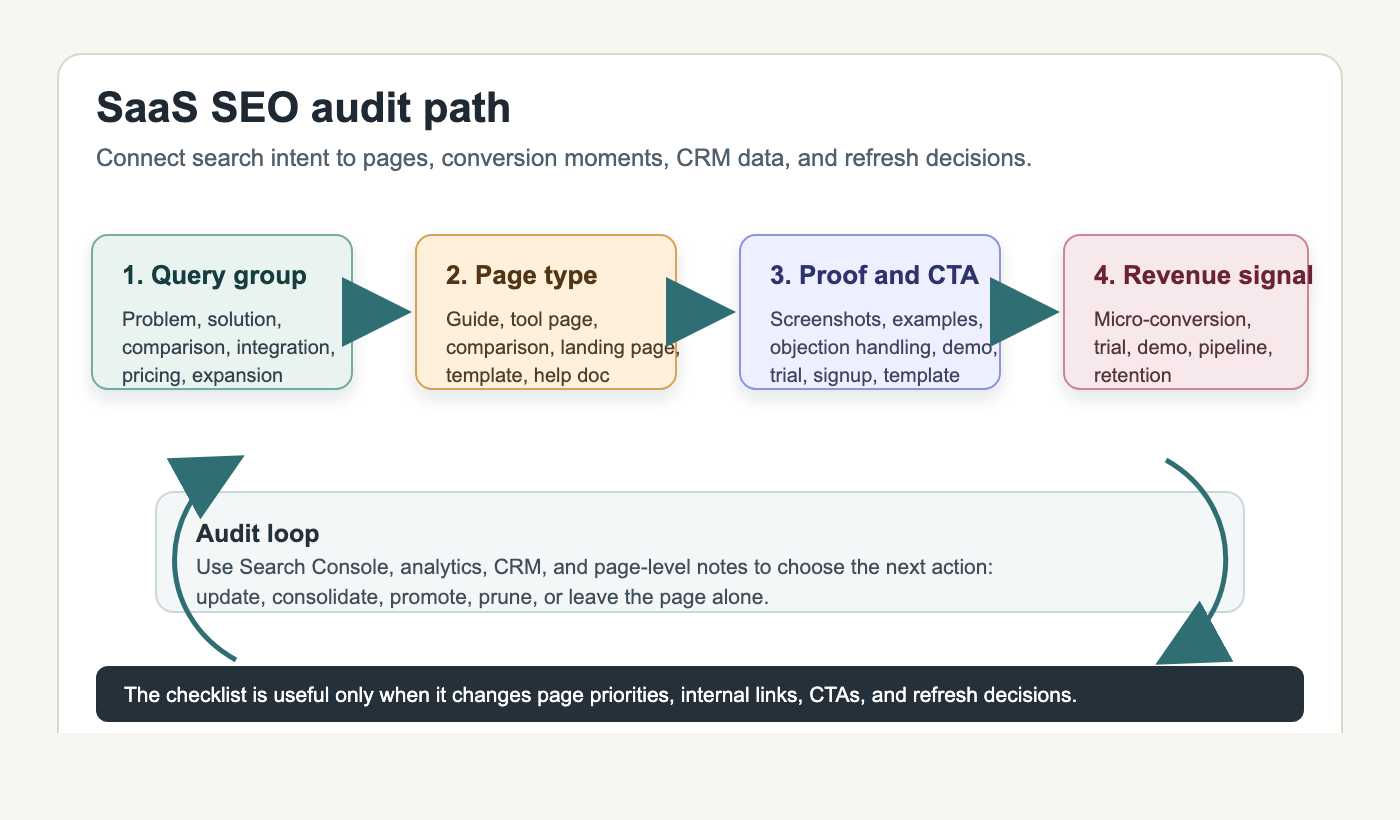
Do not expect every article to generate direct demos. Some pages build awareness, earn links, or support sales conversations. But if no part of the SEO program can connect to signups, demos, opportunities, or retention, the measurement system is incomplete. Personally, I would rather defend a smaller content program with clear pipeline influence than a large one that can only point to traffic charts.
A Monthly SaaS SEO Audit Cadence
If you want a lightweight version of the checklist, use this monthly cadence:
| Week | Focus | Output |
|---|---|---|
| Week 1 | Technical and indexation | Fix crawl, indexation, Core Web Vitals, sitemap, and canonical issues |
| Week 2 | Content and intent | Refresh declining pages and improve high-impression pages |
| Week 3 | Internal links and authority | Add contextual links, reclaim mentions, promote link-worthy assets |
| Week 4 | Conversion and reporting | Review demos, trials, assisted conversions, and page-level revenue signals |
For larger SaaS sites, add a quarterly strategy review:
- Re-map keyword clusters to funnel stages.
- Identify pages with ranking potential but weak conversion paths.
- Merge overlapping posts.
- Create or update comparison, integration, and use-case pages.
- Review whether international or multilingual SEO deserves a separate roadmap.
If multilingual growth is part of the plan, scaling SaaS SEO with multilingual automation deserves its own workflow. Translation, hreflang, local intent, and localized conversion paths can create a second SEO system inside the first one.
Final Takeaway
A good SaaS SEO checklist is not a one-time publishing task. It is a repeatable way to find ranking leaks, fix technical blockers, improve content quality, strengthen internal links, and connect organic search to revenue.
Start with the pages buyers actually use: product pages, use-case pages, comparison pages, high-traffic guides, pricing pages, and demo paths. Then work outward.
The teams that win with SaaS SEO are usually not the ones publishing the most. They are the ones that keep improving the pages buyers use to understand, compare, and choose a product. That is the checklist I would keep coming back to.