
8 Best AI Content Generators for E-commerce SEO

Yi
SEO Expert & AI Consultant

E-commerce SEO has a different content problem from most sites. I have watched stores treat AI like a catalog printer: dump the SKU list in, publish whatever comes out, and hope Google rewards volume. That is how you get 10,000 pages that all say "premium quality" and none that help a shopper pick a size.
You are not writing one blog post. You may need hundreds of product descriptions, category intros, comparison pages, buying guides, meta descriptions, image alt text, and seasonal refreshes. AI content generators can help with that load, but only as a controlled production system. A fluent paragraph that invents a material or copies the next SKU is worse than a slower draft.
The tool that wins is the one that keeps product facts, search intent, and brand voice intact when the work gets repetitive. Fluency is cheap. Specificity is not.
TL;DR: Best AI Content Generators for E-commerce SEO
If you want the short version, here is how I would choose:
| Rank | Tool | Best for | Main limitation |
|---|---|---|---|
| 1 | Junia AI | SEO-led product, category, and blog content workflows | Best when you want a full content workflow, not just one-off snippets |
| 2 | Shopify Magic | Fast product descriptions inside Shopify | Limited if you need deeper SEO planning or cross-channel workflows |
| 3 | Hypotenuse AI | Bulk product description generation and product data cleanup | More specialized around catalog content than broader SEO strategy |
| 4 | Jasper | Brand-governed marketing and catalog copy at scale | Strong writing system, but SEO workflow still needs setup and review |
| 5 | Ahrefs Product Description Generator | Quick free product description drafts | Useful for drafts, not a complete e-commerce SEO workflow |
| 6 | Frase | SERP-informed blog and category content | Better for SEO briefs and articles than bulk product catalogs |
| 7 | GetGenie | WooCommerce product descriptions and WordPress workflows | Best fit is WooCommerce, not every e-commerce stack |
| 8 | Copy.ai | Campaign, ad, and product messaging variants | More GTM/copy workflow than technical e-commerce SEO system |
For most e-commerce teams, I would choose Junia AI first because it covers the widest SEO content workflow: product descriptions, long-form articles, keyword-led planning, metadata, humanization, and bulk content production. That breadth matters once a store has more than a few SKUs. If I were running a 40-SKU Shopify shop this week, I would start inside Shopify Magic and edit hard. If the bottleneck is 8,000 rows in a product feed, Hypotenuse is the more honest fit.
How I Ranked These Tools
I did not rank these tools only by how fluent the writing sounds. Fluent copy is easy now. In my experience, the harder test is whether the tool can keep product facts, search intent, and page structure intact when the workload gets repetitive.
I looked for tools that can help with:
- Product descriptions that use real product attributes instead of vague adjectives.
- Category copy that targets buyer intent without becoming thin filler.
- Blog posts and buying guides that support topical authority.
- Metadata, headings, FAQs, and internal links that fit the page naturally.
- Bulk workflows for larger catalogs.
- Human review, brand voice, and content consistency.
- AI Search readiness, meaning the content is structured enough to be quoted, summarized, and understood by search systems.
The keyword side matters too. Before generating copy, I would use real query data or a focused AI keyword research workflow so product pages, category pages, and guides are not built around guessed phrases. I have seen too many AI content workflows start with a prompt and only later ask whether anyone searches for the page topic.
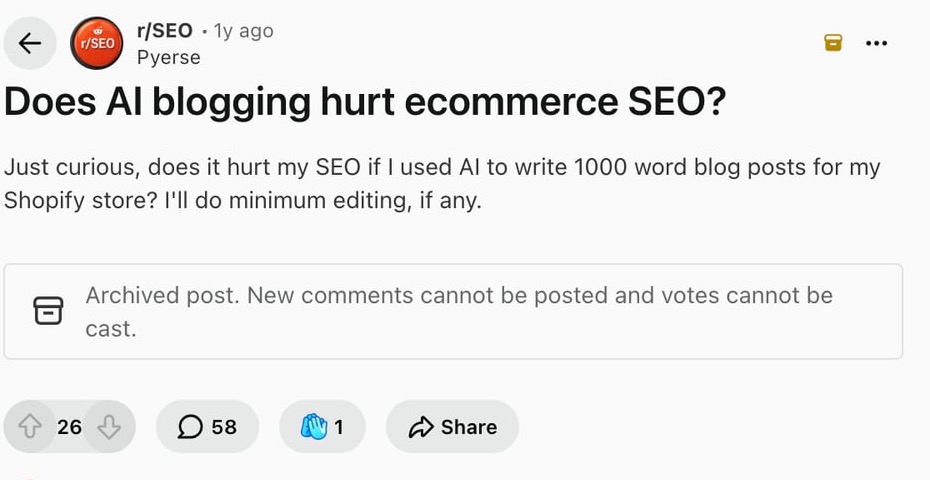
Google's own guidance is still the right guardrail here: AI-generated content is not automatically bad, but using automation to generate many pages without adding value can cross into scaled content abuse. That makes editorial review, product specificity, and clear page purpose non-negotiable for e-commerce SEO. Google's guidance on generative AI content is worth keeping beside your workflow.
The concern on the other side is that teams use AI to publish many pages without adding value. This is a real risk that people often talk about: it was not "AI" by itself; it was publishing lightly edited posts and hoping volume would carry the strategy.
1. Junia AI
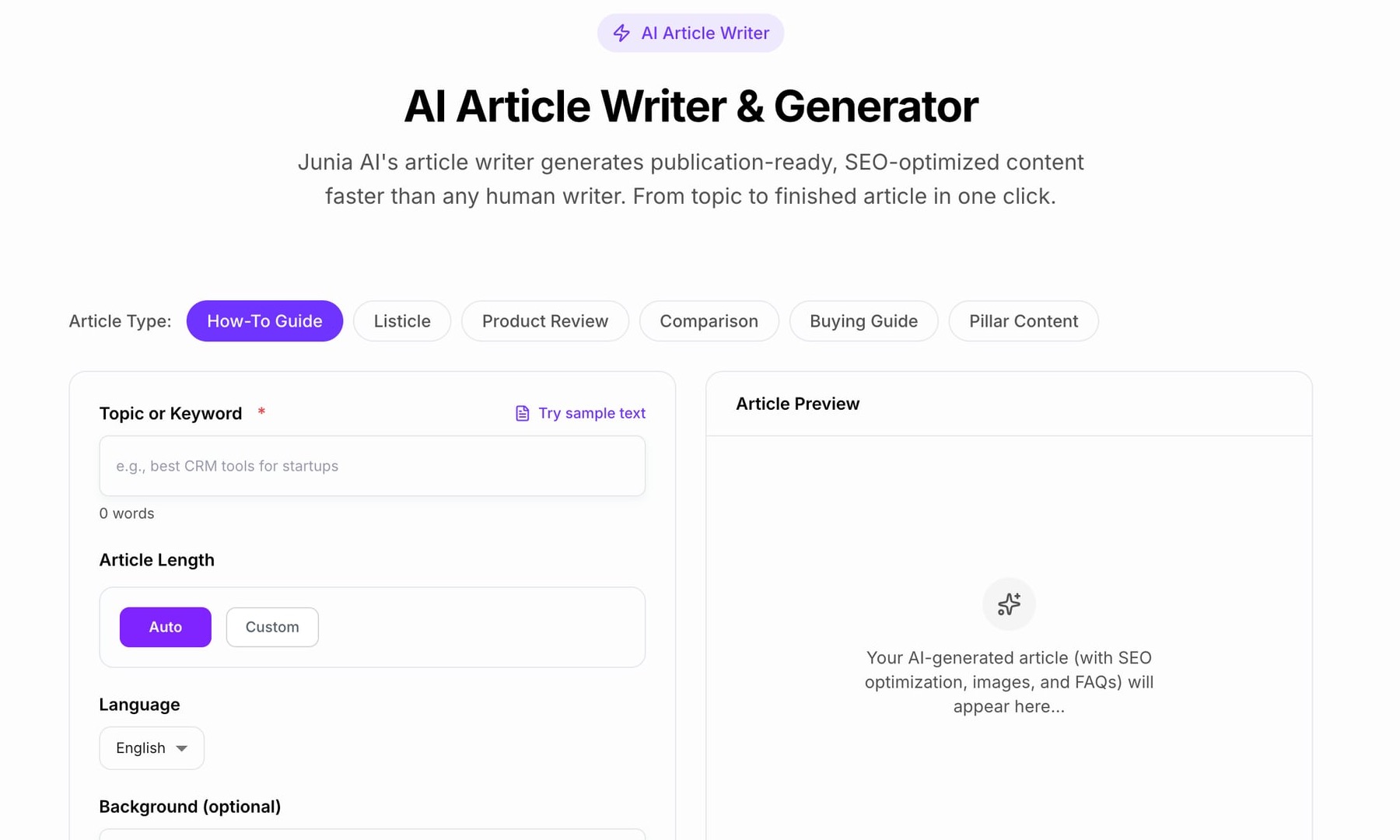
Junia AI is my top pick for e-commerce SEO because it is built around SEO content production, not just generic text generation.
That matters more than it sounds. A basic AI writer can produce a product paragraph. A stronger e-commerce SEO tool should help you connect the product page to the wider search strategy: keyword intent, blog support, internal links, metadata, topical coverage, and refreshes.
Junia AI fits that broader workflow well. You can use it for product descriptions, SEO blog posts, product-led guides, category content, title ideas, meta descriptions, and content updates. If your store depends on organic search, that range is more useful than a tool that only writes short product blurbs. Personally, I value that because e-commerce SEO rarely breaks in just one place; the weak point is usually the handoff between product copy, category copy, and supporting content.
The workflow fit matters. I prefer tools that make the page type, keyword, length, and preview visible instead of forcing every e-commerce SEO task through a blank chatbot prompt.
Why Junia AI is #1 for e-commerce SEO
Junia is strongest when you need content that is both scalable and search-aware. For example, an e-commerce team can use it to create:
- AI-generated product descriptions from product attributes, benefits, use cases, and target keywords.
- Blog posts that answer pre-purchase questions before shoppers compare products.
- Buying guides that connect informational searches to product categories.
- Metadata and headings that match the page's search intent.
- Supporting articles that strengthen internal links across a product cluster.
That last point is important. A store usually does not rank because one product page has a slightly better description. It ranks because the whole site explains the category better than competing stores. Product pages, collection pages, comparison posts, and guides need to reinforce each other. When that cluster is thin, even good individual pages feel isolated.
This is where Junia's SEO-first workflow is useful. A focused AI article writer can turn product questions into long-form content, while a product description workflow handles the shorter conversion copy. The supporting articles should earn the click by answering a real pre-purchase question, not by existing so the product page has somewhere to link.
Best use cases
Use Junia AI when you want one system for:
| Use case | What Junia helps with |
|---|---|
| Product descriptions | Drafting specific, SEO-friendly copy from product details |
| Category pages | Adding buyer-focused context to pages that would otherwise be product grids |
| Blog content | Building search-led posts around comparisons, questions, and buying advice |
| Metadata | Creating title and description options that match the page promise |
| Bulk content | Scaling repeatable content without starting every page manually |
| Humanization | Improving rhythm, clarity, and specificity before publishing |
I would especially use Junia for stores that publish both product pages and content marketing. If the store only needs a few descriptions, a simpler tool might be enough. If the store needs a full SEO content engine, Junia is the better starting point.
2. Shopify Magic
Shopify Magic is the best option if you run a Shopify store and need product descriptions directly inside the admin.
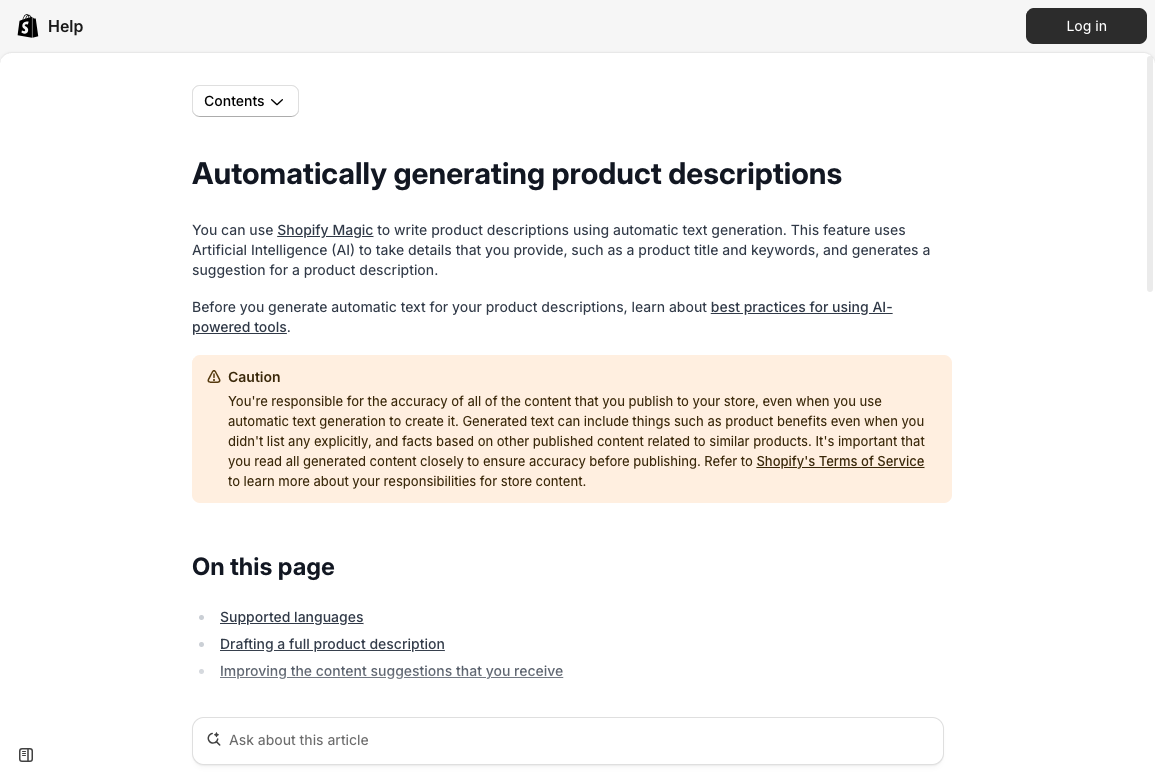
The appeal is obvious: no extra writing app, no separate export process, and no complicated setup. Shopify says its product description feature uses the product title and keywords you provide to generate a suggested description. For many small stores, that is enough to move faster when launching or cleaning up products. I would not overcomplicate this if the immediate job is simply turning sparse product records into usable first drafts.
Shopify's own help docs are unusually blunt about the risk: generated copy can invent benefits you never listed. That is the part I take seriously. The draft is free. The unedited publish is not.
If you want the in-admin walkthrough, Shopify's own video is clearer than most third-party demos:
Shopify AI: How to automatically write product descriptions with Shopify Magic
Where Shopify Magic works well
Shopify Magic is useful when:
- You already manage products in Shopify.
- You need a first draft quickly.
- You want a simple tone setting.
- You are writing one product at a time.
- You do not need a separate SEO content platform.
The limitation is that Shopify Magic is not a full SEO strategy. It can help you create a description, but it will not automatically decide which category pages need unique copy, which blog topics support the product, or how the page should fit into your internal link structure.
So I would treat Shopify Magic as a fast product-page assistant. Use it for the draft, then edit for product accuracy, search intent, and conversion value. If a product page needs deeper optimization, pair the description with stronger SEO-optimized product descriptions rather than relying on the generated copy alone.
3. Hypotenuse AI
Hypotenuse AI is a strong option for teams that care most about bulk product content.
Its positioning is very e-commerce-specific: generate product descriptions in bulk, apply brand voice, optimize product page content, and manage product data more cleanly. That makes it a better fit for catalog-heavy stores than a general-purpose writing tool.
Where Hypotenuse AI stands out
Hypotenuse AI makes the most sense when your main problem is volume:
- You have hundreds or thousands of products.
- Product attributes live in spreadsheets, feeds, or a product information system.
- You need consistent formatting across descriptions.
- You want to generate meta titles or product copy in batches.
- You need a more organized review workflow than copy-pasting from a chatbot.
This is the right kind of tool to consider when product data is the bottleneck. If the product title, material, dimensions, color, warranty, compatibility, and use case are already structured, AI can turn those inputs into clearer copy faster than a human team can write every page from scratch. The part I would not skip is the product-data cleanup before generation; it is dull work, but it decides the quality ceiling.
The risk is the same as with any bulk workflow: if the inputs are messy, the output will be messy at scale. Before using any bulk generator, standardize your attributes and decide which details must never be invented. For product pages, those details include size, material, ingredients, fit, compatibility, price, stock status, shipping promises, and anything safety-related. This is where bulk AI can become either a useful production system or a very fast way to multiply small errors.
4. Jasper
Jasper is best for teams that already think in terms of brand systems, campaigns, and marketing operations.
For e-commerce, Jasper can be useful when you need product descriptions, marketplace copy, email copy, ad variants, and campaign messaging to sound like the same brand. That is a real advantage for stores with multiple channels, especially if several people are producing copy.
Where Jasper fits
Use Jasper when:
- Brand voice consistency is more important than basic draft speed.
- You need copy for DTC, marketplace, email, and paid campaigns.
- You want reusable instructions for product and audience context.
- Your team has a review process for generated content.
The brand voice setup is the part I would take seriously. A store selling technical parts, luxury skincare, and novelty gifts should not use the same default tone, and a clear tone guide makes generated copy easier to review.
I would not use Jasper as the only SEO system unless the team also has keyword research, content planning, internal linking, and technical SEO covered elsewhere. It can create strong marketing copy, but e-commerce SEO still needs a strategy around product pages, category pages, and supporting content. My bias here is fairly strong: brand voice is valuable, but it cannot compensate for weak page purpose.
That is especially true for large catalogs. A product description should not only sound good. It should answer the shopper's actual comparison questions and include the details search systems need to understand the page.
5. Ahrefs Product Description Generator
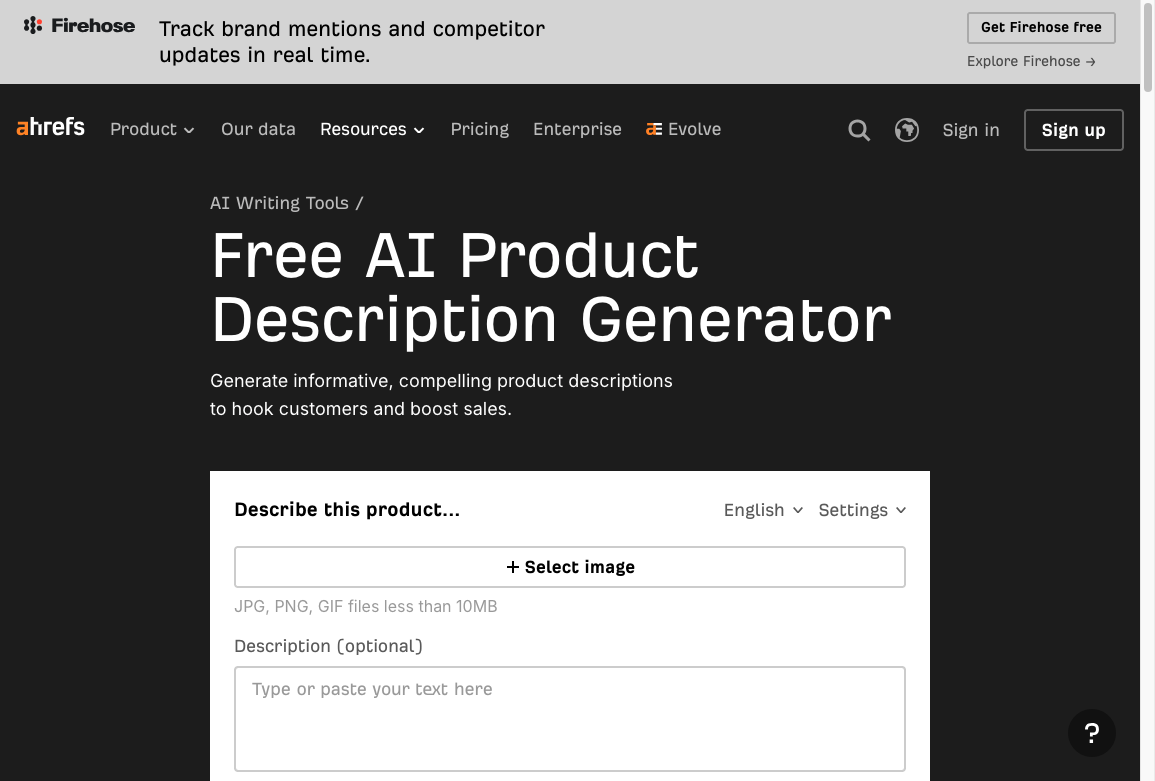
Ahrefs' product description generator is useful because it is quick and free.
That makes it a good lightweight option for small stores, early drafts, or teams that need a few wording options before editing. You add product details, choose a tone or format, and use the result as a starting point. I use it when I want three angles for one SKU before I commit to a voice, not when I am trying to rewrite a catalog.
Where Ahrefs works well
Ahrefs is a sensible choice when:
- You need a fast draft for a small batch of products.
- You want to test a few description angles.
- You already handle SEO planning somewhere else.
- You do not need a full content management workflow.
The main limitation is workflow depth. A free generator can help with the sentence-level copy, but it will not solve larger e-commerce SEO problems like duplicate category pages, missing internal links, weak product schema, thin buying guides, or outdated seasonal content. I like free generators for creative friction, not for operational SEO.
Use it when the job is small. Move to a fuller system when the job becomes repeatable.
6. Frase
Frase is strongest for SERP-informed content briefs and long-form SEO content.
For e-commerce, that makes it more useful for blog posts, buying guides, comparison pages, and category-supporting articles than for writing thousands of product descriptions. If you are trying to rank for queries like "best running shoes for flat feet" or "linen vs cotton sheets," Frase can help identify the subtopics competitors cover and turn that into a stronger outline.
Where Frase helps e-commerce teams
Frase is useful when:
- Blog posts and buying guides drive a large share of organic traffic.
- You need SERP-informed outlines.
- You want to refresh older content against current ranking pages.
- You care about topical coverage and content gaps.
The tool is less ideal when your main task is catalog copy. For that, a product-description-specific workflow will usually be faster.
Still, Frase can support the part of e-commerce SEO that many stores neglect: informational content that helps shoppers before they are ready to buy. I would use it for the questions shoppers ask before they trust a product page. Those articles can connect naturally to product categories, especially when internal links are chosen for the reader's next decision rather than added mechanically.
7. GetGenie
GetGenie is worth considering if your e-commerce store runs on WordPress and WooCommerce.
Its strength is proximity to the publishing workflow. Instead of writing descriptions somewhere else and moving them into WordPress, a WooCommerce-focused tool can make product copy and page optimization feel more native.
Where GetGenie fits
Use GetGenie when:
- Your store runs on WooCommerce.
- You want AI writing inside WordPress.
- You need product descriptions, blog drafts, or SEO-focused copy.
- You prefer a plugin-style workflow over a separate content platform.
The main thing to watch is tool overlap. WooCommerce stores often already have SEO plugins, schema plugins, image optimization plugins, and content tools installed. Adding another AI tool can help, but it can also create a messy stack if every plugin tries to solve the same problem. In practice, plugin clutter often creates more review work than the AI tool saves.
For WooCommerce SEO, keep the stack simple. Decide which tool handles product copy, which tool handles technical SEO, and which tool handles analytics. Do not let five plugins rewrite the same metadata in different ways.
8. Copy.ai
Copy.ai is useful for campaign and GTM copy, especially when you need variations.
For e-commerce SEO, I would use it for supporting copy rather than as the core SEO system. It can help generate product angles, ad copy, email snippets, landing page variants, and short-form promotional messaging. That is helpful when a product launch needs many versions of the same idea.
Where Copy.ai works best
Copy.ai is a good fit when:
- You need many messaging variants.
- Product marketing and sales copy matter more than long-form SEO.
- You want campaign assets around product launches.
- Your SEO planning is already handled by another tool or team.
The limitation is that campaign copy and organic search content are not the same job. A catchy product line can work in an email but still fail on a product page if it omits material, sizing, compatibility, or other buyer-critical details. I would rather have a slightly plain product page that answers the right questions than a clever one that dodges them.
So use Copy.ai for messaging expansion. If those messages send shoppers back to the store, make sure each landing page has a clear conversion path instead of sending every visitor to a generic product grid.
What Makes an AI Content Generator Good for E-commerce SEO?
The best e-commerce AI content generator is not the one that writes the fanciest sentence. It is the one that helps you publish content shoppers can trust. That sounds less exciting, but it is the standard that actually holds up after the content goes live.
Here is the practical evaluation checklist I would use:
| Requirement | Why it matters |
|---|---|
| Product attribute control | Prevents invented details and keeps copy tied to real product data |
| Brand voice settings | Keeps descriptions consistent across large catalogs |
| SEO inputs | Helps the draft match actual search demand |
| Bulk generation | Saves time on large catalogs when inputs are clean |
| Metadata support | Improves title tags and descriptions at scale |
| Human review workflow | Catches accuracy, compliance, and brand issues before publishing |
| Content refresh support | Keeps seasonal and inventory-sensitive pages current |
| Internal linking support | Connects product, category, and guide content naturally |
I would also check whether the tool helps with structured content. Google can use product structured data for merchant listing experiences that show details such as price, availability, shipping, and returns. A writing tool does not replace technical SEO, but the copy still has to match the facts in the feed. If the description says "in stock" and the markup says otherwise, you have built a trust problem, not an SEO asset.
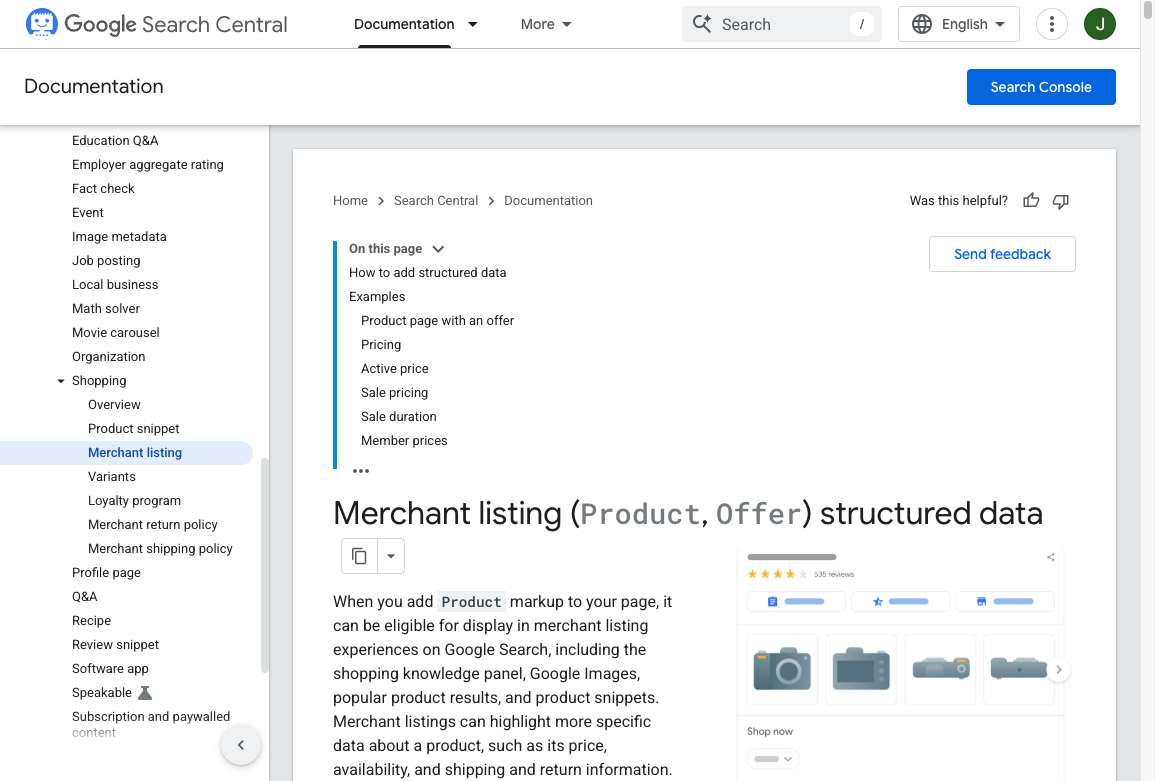
Google's merchant listing structured data documentation is the checklist I keep next to the writing workflow. Keep the visible copy, title tag, product feed, and markup in agreement before you scale.
A Simple Workflow for Using AI Without Creating Thin Product Pages
AI content fails in e-commerce when teams generate many near-identical pages and call it SEO. I have found the safer workflow is slower at the start and much faster later: define the rules once, then scale inside those rules.
Do not generate 10,000 thin SKUs and call it SEO. I would rather rewrite 80 money pages with real attributes, size notes, and "who this is not for" than flood the index with near-duplicates. Google's scaled-content rules are not theoretical on a catalog. Thin pages get ignored. Misleading pages create returns.
The difference is usually visible in one glance:
| Thin product page | Useful product page |
|---|---|
| Generated from the title plus "premium" adjectives | Built from materials, fit, use case, exclusions, and care details |
| Same 90 words as the next SKU, with the color swapped | Explains the one difference a shopper is actually comparing |
| No size, compatibility, or restock truth | Facts match the feed, schema, and what support will honor |
| Published in bulk with no review gate | Reviewed against a checklist before it goes live |
Use this process:
- Start with product data. Gather title, category, material, size, color, use case, audience, benefits, compatibility, warranty, and exclusions.
- Add search intent. Decide whether the page needs to rank for product-specific, category, comparison, or problem-aware queries.
- Generate one page type at a time. Do product descriptions first, category copy second, and blog content separately.
- Edit for truth. Check every factual detail before publishing, especially numbers, claims, compatibility, and availability.
- Add useful internal links. A product page might link to a buying guide; a buying guide might link to a category; a category page might link to a comparison article.
- Check metadata and structured data. Make sure the visible copy, title tag, product feed, and schema do not contradict each other.
- Measure performance. Track rankings, impressions, clicks, conversions, and assisted revenue by page type.
For larger catalogs, bulk content creation only works when each page type has its own rules. Product descriptions, collection pages, and blog posts should not share the same prompt because they do not serve the same reader. This is one of the easiest shortcuts to take, and usually one of the first problems I would fix. Treat a large batch as a publishing system with gates, not a single prompt. The review rules matter more as volume increases.
How to Optimize AI-Generated E-commerce Content for AI Search
AI Search visibility depends on the same foundation as good SEO: clear pages, helpful content, accessible structure, and reliable facts. Google's guidance for generative AI features says the core SEO best practices still apply because these experiences are rooted in Google's search systems.
For e-commerce content, that means your pages should be easy to extract and summarize:
- Put the direct answer early.
- Use descriptive headings.
- Include concise comparison tables.
- State who each tool or product is best for.
- Avoid vague hype claims.
- Keep product facts consistent with feeds and structured data.
- Add examples where a reader might otherwise misunderstand the use case.
This is also why listicles still work when they are honest and useful. A clear ranked list gives both readers and AI systems a simple answer: which tool to choose, why it fits, and when it is not the right choice. The key is the caveat. A list that never says "this is not for you" is usually just a sales page in disguise.
Common Mistakes to Avoid
The first mistake is publishing generated product descriptions without checking the product facts. If the AI invents a material, size, ingredient, compatibility detail, or guarantee, the page can mislead shoppers. This is the mistake I would treat as non-negotiable because it affects trust, returns, and support tickets, not just rankings.
The second mistake is writing every product page from the same template. Similar products need shared structure, but each page still needs a reason to exist. Variation copy should explain the difference that actually matters: fit, use case, size, finish, bundle contents, or buyer intent. If two generated pages can be swapped without anyone noticing, neither page is specific enough.
The third mistake is treating blog content as separate from the catalog. Strong e-commerce blogs should support product discovery. A guide about choosing running socks should naturally help readers compare sock materials, thickness, and use cases before reaching the product category.
The fourth mistake is skipping the humanization pass. A tool can create a decent first draft, but the final version still needs rhythm, specificity, and judgment. Turning AI-generated content into humanized content is not about hiding AI use. It is about making the page clearer, more accurate, and more useful.
The fifth mistake is ignoring measurement. If AI helps you publish faster but organic clicks, conversion rate, or assisted revenue do not improve, the workflow needs to change. More pages are not the goal. Better pages are.
Final Recommendation
If you want the best overall AI content generator for e-commerce SEO, choose Junia AI.
It gives you the broadest SEO content workflow: product descriptions, long-form articles, keyword-led content, metadata, bulk production, and editorial improvement. That makes it a better fit for stores that want to grow organic visibility across product pages, category pages, and supporting content. If I were building an e-commerce SEO workflow from scratch, I would rather start with one search-aware system and simplify later than stitch together five narrow tools too early.
Choose Shopify Magic if you only need quick descriptions inside Shopify. Choose Hypotenuse AI if your main challenge is bulk catalog copy. Choose Jasper if brand-governed marketing copy is the priority. Use Frase when blog and buying-guide SEO are the bigger bottleneck.
The real win is not replacing your content team. It is giving them better first drafts and more time to add the product knowledge a shopper actually uses: fit, materials, who it is for, and what the next SKU does differently. If the page could be swapped with its neighbor and nobody would notice, it is not ready.