
6 AI Content Use Cases for SEO (With Workflows + Prompts)

Yi
SEO Expert & AI Consultant

Which AI content jobs are actually worth doing
AI content is most useful in SEO when it speeds up repeatable work without lowering quality. That includes drafting, clustering, refresh workflows, and operations that stall because the manual workload is too high.
The important part is not publishing more. It is using AI for research, production, and optimization while keeping a human on the final pass.
| Use case | What AI should do | What still needs a human |
|---|---|---|
| Guest / third-party pages | Draft a specific pitch, not 40 near-copies | Platform rules, uniqueness, disclosure |
| Automation | Cluster keywords, score refreshes, draft metadata | Which pages deserve the work |
| Content refresh | Flag stale sections and missing answers | The rewrite that adds a new example |
| Semantic coverage | Surface related questions | Whether those questions belong on this URL |
| Autoblogging | First drafts against a brief | QA before anything goes live |
| Topic clusters | Map overlapping URLs | Which page owns which query |
If you want one stack rather than six disconnected prompts, start with AI SEO tools and keep the workflow narrow.
What AI actually speeds up
- First drafts for pages you already understand
- Refresh notes on old URLs
- Cluster maps that would take a day in a spreadsheet
- Metadata variants you still have to edit
Challenges of Using AI-Generated Content for SEO
- Making sure the content actually feels genuine and original, not like some copy-paste robot stuff
- Trying to find that sweet spot between SEO and simple, easy-to-read, user-friendly content that people actually want to read
- Figuring out, and honestly keeping up with, all the search engine rules and actually following them
When you’re using AI in your SEO strategies, you really have to remember there’s a balance between all the precise algorithms and real human creativity. If you use it carefully and kinda thoughtfully, AI can definitely help boost your online visibility.
1. Create Lots of Content for Free Using Parasite SEO
Parasite SEO is kind of a special SEO method where content creators sort of “borrow” the strong reputation of big well known websites to boost their own content. Basically, they create free pages or profiles on popular sites and then use those sites’ SEO power to help themselves. This can mean things like writing guest posts, making profiles, or even joining forums just so they can link back to their own website and get more traffic from it.
How AI Tools Help Automate Creating Many Parasite Pages
AI content tools are super helpful when you want to make a lot of parasite pages really fast. They can pump out tons of content that fits different platforms and different types of audiences. You can basically use AI to:
- Create Content: Quickly make large amounts of content, which is great when you want to cover a bunch of host sites at once.
- Customize Posts: Adjust the tone and style of posts so they match the audience and the rules of different platforms, so it doesn’t feel out of place.
- Improve Keywords: Add important keywords smoothly into the content to help with SEO, while still keeping decent readability, so it doesn’t sound too forced.
- Fix Grammar: Use our AI grammar checker to quickly clean up grammar mistakes, so your writing looks pretty much error-free.
- Rewrite Content: Use our paraphraser tool to reword existing content while keeping the same meaning, which makes it easier to reuse it on different platforms or in slightly different situations.
Pros and Cons of Using Mass Parasite Pages for SEO
Using mass parasite pages can be really helpful for SEO, but yeah, there are some pretty important downsides to think about too:
Pros:
- Use Established Authority: You can kind of “borrow” the strong reputation of big well-known websites without spending a ton of time on building links.
- Faster Visibility: Your stuff can get noticed way quicker since those popular sites already have a lot of visitors coming in daily.
- Low Cost: A lot of high-authority sites let you publish content for free, so it becomes a pretty cheap SEO method overall.
Cons:
- Risk of Penalties: If you use too many pages or the pages are low quality, search engines might see it as spam and give you penalties.
- Limited Control: The host site decides how long your content stays live and how visible it is. And honestly, they can change that whenever they want.
- Weakened Brand: If you rely too much on other people’s sites, your own brand identity can get a bit lost and you might get fewer visitors directly on your own site.
If you use AI tools to create mass parasite pages, try to balance quantity with quality. Like, don’t just spam stuff. Make content that’s actually useful and improves the user experience, while still using SEO in a natural way. Remember, AI makes everything faster and easier, but human review ensures ethical standards and helps protect your brand’s image.
AI is changing how we work and live in general. At work, automation takes care of boring routine tasks so people can focus more on the important projects. AI analytics help with making better decisions by finding patterns in data that we’d probably miss. In daily life, virtual assistants help manage stuff like schedules and communication and reminders and all that.
New AI tools use natural language processing (NLP) to create pretty high-quality writing with very little human help. They can write blog posts, marketing copy, and social media content that’s tailored to specific audiences. AI is also getting used more and more for video and audio creation, like automatically editing videos or generating voiceovers from scripts, which is kind of wild.
To get the most out of mass parasite pages:
- Find trusted platforms that are actually related to your field or niche.
- Use AI-generated content carefully, really focus on quality, relevance, and keeping users engaged.
- Check your pages regularly to make sure they still follow the host’s rules and search engine guidelines.
By using AI tools responsibly in your mass parasite page strategy, you can boost your online presence in a pretty effective way. Just always think about how it affects your brand in the long run and stick to SEO best practices as closely as you can.
A Practical Workflow for Parasite SEO Content
If you are experimenting with parasite SEO, the safest use of AI is operational, not fully automated. A better workflow looks like this:
- Choose a host platform that is relevant to your niche and clearly allows the type of content you want to publish.
- Use AI to build a first draft that matches the platform format and audience expectations.
- Add original examples, proof, screenshots, or commentary before publishing.
- Review for platform rules, spam risks, and brand fit.
That matters because parasite SEO can create visibility quickly, but it also carries real platform and reputation risk. AI helps most when it reduces drafting time while a human still controls quality and compliance.
2. Improving SEO with Automation: How AI Helps Create Content
SEO automation works best when it handles repeatable, low-leverage tasks that still need consistency. Think meta descriptions, internal-link suggestions, page briefs, SERP pattern analysis, and first-draft support for large content sets.
This is especially useful for sites with many templates, categories, locations, or product pages. For example, a meta description generator can speed up metadata creation, while AI-assisted briefs can help teams publish pages with more consistent structure and search intent coverage.
What automation is actually good for
The main benefits are straightforward:
- Scalability: You can support larger content inventories without expanding manual effort linearly.
- Efficiency: Teams spend less time on repetitive formatting, drafting, and optimization tasks.
- Consistency: Metadata, briefs, and page structures become more uniform across large sites.
- Faster testing: You can iterate on titles, descriptions, and content angles more quickly.
- Better prioritization: AI can surface patterns in performance data that help teams decide what to update next.
How Automation Helps Analyze Data and Improve SEO with AI Content Creation
You can use AI tools to automate your SEO work, like, a lot of it. These tools can quickly go through huge amounts of data, find patterns you might miss, and give you useful insights that help shape your strategy. They’re really helpful for things like finding keywords, checking out what competitors are doing, and creating AI-generated content.
Here are some ways AI tools can boost your SEO efforts:
- Website Improvement: AI tools that suggest changes to your site’s structure and content, so you can make it easier to use and maybe rank better too.
- Quick Adaptation: Algorithms that notice when search engine rules get updated, so you can adjust fast instead of falling behind.
- Personalized Content: Machine learning that predicts what users want to see, helping you customize your content to match what they’re actually looking for.
New trends in AI Content Creation include advanced models like ChatGPT 5 and Claude 4 Sonnet, which can understand and create language in a way that feels way more natural and accurate.
Popular AI Tools for Improving SEO
Several tools can support this workflow in different ways:
- MarketMuse: Useful for content analysis, coverage gaps, and topic depth.
- SEMRush: Helpful for keyword research, SEO workflows, and competitive analysis.
- Junia AI: A practical option for drafting, optimization, and broader content workflows.
- Jasper AI: Useful when teams want more campaign-oriented writing support.
- SurferSEO: Best known for optimization guidance tied to ranking-page patterns.
The right choice depends less on branding and more on workflow fit. If you want a broader look at options, it also helps to compare the best AI content generators in 2026.
How Programmatic SEO Can Boost Your Website
Programmatic SEO uses technology to help improve your website’s ranking on search engines, and kind of just make the whole site easier and nicer for people to use. When it’s done right, this approach can give you a pretty big edge in search results, sometimes more than you’d expect honestly.
Using AI tools like ChatGPT 5 and Claude 4 Sonnet for programmatic SEO helps you keep up with the latest SEO methods and trends and stuff. Just remember, these tools are really meant to create useful and interesting content that actually fits into a smart SEO plan, not random fluff, and really benefits your audience in the long run.
3. Updating Existing Content
When you put some effort into updating existing content, you’re not just cleaning up old blog posts or whatever. You’re actually making your whole SEO strategy stronger. Search engines like Google really like fresh and relevant stuff. So by going back, reviewing, and improving what’s already on your site, you give your pages a better chance to stay visible and competitive in search results.
Why Updating Content Matters for SEO
- Stay Relevant: It’s important to go back and update old facts or numbers so your content stays accurate and doesn’t feel out of date.
- Better Rankings: Search engines usually like content that gets updated regularly, so yeah, keeping things fresh can help your rankings.
- More Engagement: When your content feels new and fresh, visitors are more likely to stick around and not just click away right away.
- Build Trust: Sharing the latest information helps your site become a trusted source, which is really important for building SEO authority.
Google's Helpful Content Update and How It Affects Rankings
Google's helpful content update is basically meant to reward content that actually helps people, like real users, not just search engines. It lowers the ranking of pages that are mostly made just to rank well in search and not really to give real value. So yeah, this change makes it extra important to:
- Make sure your content actually matches what users are looking for, not just what you think might rank
- Avoid overusing keywords, because stuffing them in everywhere looks bad and doesn’t really help
- Create content focused on people first while still following SEO best practices so it can still show up
When you’re updating your content, try asking yourself stuff like:
- Is the information useful and clear for someone searching this topic, like would it make sense to them?
- Does it fully answer the user's question or am I leaving them hanging?
- Would someone feel they learned enough after reading it, or would they need to click back and look for more?
Volume without review is the failure mode. I would rather refresh eight URLs that already get impressions than generate 80 new pages that say the same thing.
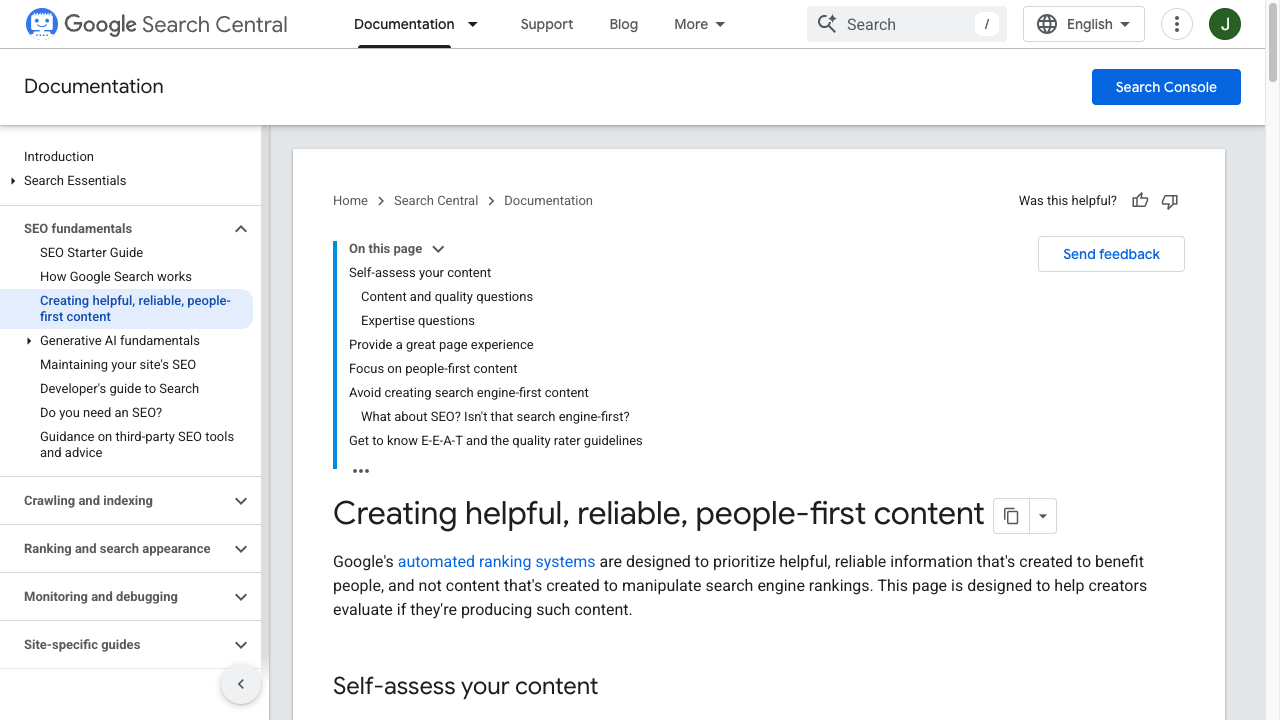
A practical refresh looks like this: open the live URL, find the thin or outdated section, and rewrite that part against current search intent.
How to Update Old Blog Posts for SEO
Using AI Tools to Update Content More Easily
With Google's helpful content update, AI tools can make updating your content a lot faster and honestly just easier to deal with:
Content Review
AI can look through your articles really quickly and spot parts that are outdated or kinda weak. It can suggest topics that need more detail or more recent information so you don’t have to find everything yourself.
Keyword Improvement
AI tools check how keywords are doing and then recommend changes that might help your pages rank better on search engines. So you can see what’s working, what’s not, and what to fix.
Quality Check
Some AI programs review how easy your content is to read and suggest ways to make it clearer and more engaging. Like, they can point out confusing sentences or places where people might get bored.
Adding Related Terms
They can also help add related keywords and phrases to strengthen your content’s relevance on a topic, which is pretty helpful when you’re trying to cover something fully.
Using these AI tools in your work makes it a lot easier to keep your website’s content up-to-date and in line with Google’s goal of rewarding helpful, informative content. It’s basically just a way to keep things fresh without doing every little thing by hand.
4. Improving SEO with Semantic Content Optimization
Semantic content optimization is a really important SEO strategy that does more than just stuffing keywords into your content. It’s more about actually understanding the main topics and related ideas that search engines pay attention to when they rank pages. This method focuses on why people are searching in the first place, like the real reason behind their search, and tries to give full, helpful information that actually answers their questions.
What semantic coverage should change on the page
Here’s how semantic optimization can help your SEO, kind of in a bunch of connected ways:
- Improves search relevance: It basically lines up your content with what people are actually searching for, not just the exact words they type. That way, search engines can more easily tell how your page fits certain searches and why it should show up.
- Makes content easier to understand: Search engines are a lot better at understanding context now. So semantic optimization helps them get what your content really means, not just the keywords. When they understand that better, it can help your rankings go up.
- Boosts organic visibility: When you cover related topics in a full, kind of in depth way, it makes you look more like an authority. That can help your site rank higher for more relevant keywords and show up more often in organic results.
How AI-Generated Images Help Improve Meaning in Content
Recently, AI has made it possible to enhance the meaning of content by creating images, which is pretty cool actually. So yeah, here’s how AI-made images can help improve your content in a simple way:
- Visual Understanding: AI-generated images give extra visual clues that help both readers and search engines understand your content better. People just get things faster when they can see it.
- Relevance: Custom images made for specific parts of your text make the connection stronger between what you write and the pictures. It kind of keeps everything on the same page, literally and, well, not literally.
- Engagement: AI-created images can make your content more interesting to look at, which usually helps improve search rankings because people stay on the page longer.
Tools like OpenAI’s DALL-E can create images from text descriptions, showing how AI is making web pages more meaningful and not so plain. Also, with tools like an image caption generator, you can quickly add catchy and relevant captions to your images without thinking too hard about it. Plus, an image to text generator lets you turn images into words using AI, which helps you describe them better and keep readers engaged, or at least not bored.
How ChatGPT Affects Content Creation and Semantic Optimization
ChatGPT has gotten a lot of attention lately for how it helps people create content using AI. It can write stuff that really sounds like a real person, which is kind of cool, but there are a few important things to think about when it comes to semantic optimization:
- Authenticity Issues: Even though ChatGPT can write relevant content, it might not have the deep knowledge or small, subtle understanding that real human experts usually have.
- Originality Questions: A lot of people wonder if AI-made content is truly original or if it’s just taking information that already exists online and rearranging it in a new way.
Still, even with those concerns, ChatGPT gives some pretty helpful benefits for SEO professionals:
- Generating Ideas: You can use ChatGPT to brainstorm ideas or expand on topics. Just make sure you go through the content carefully afterward and double check it.
- Drafting Content: You can use ChatGPT’s speed to create first drafts really quickly, then have human editors clean it up and improve it so it matches quality standards like EEAT (Expertise, Authoritativeness, Trustworthiness).
Using AI tools like ChatGPT and AI-generated images can seriously boost your semantic content strategies and help improve your SEO results. But they should be there to support human creativity and judgment, not completely replace it. When you find the right balance, you can build a stronger online presence that works well for search engines and also actually appeals to your audience.
If you're looking for alternatives to ChatGPT that can also help with content creation and semantic optimization, you might want to check out some of the top ChatGPT alternatives.
5. Bulk Content Creation for Auto Blogging Sites
Auto blogging sites usually pump out a lot of content really fast so they can cover many different topics and pull in visitors from search engines. This is called bulk content creation. The main idea is to make a high number of posts quickly, instead of spending a lot of time worrying about every tiny detail in each one.
To speed things up, tools like the headline generator are super helpful. They help you quickly come up with catchy headlines that grab your audience’s attention without you staring at a blank screen forever.
Also, using a text generator can make bulk content creation a lot easier, since it lets you create clear and original text pretty quickly. And on top of that, a sentence generator can really improve your content quality by helping you write smooth and interesting sentences fast. It kind of kills writer’s block and makes it simpler to keep creating engaging posts over and over.
What is Bulk Content Creation?
Bulk content creation basically means creating a whole bunch of articles or posts in a short amount of time. It’s usually used by auto blogging sites that rely on automated tools to pump out content fast, so it can rank well in search engines without needing much actual human work at all.
Advantages and Disadvantages of Using AI for Large-Scale Content Creation
Using AI tools can help you pump out a lot of content really fast, but yeah, there are a few downsides you should think about too. So, here are the main benefits and drawbacks, kind of summed up:
Advantages:
- Speed: AI can produce content way faster than people, which saves a lot of time and honestly, a lot of effort too.
- Lower Costs: When you use AI, you might not need as many human writers, so it can help cut down on expenses.
- SEO-Friendly: AI tools often create content that’s already optimized for search engines, which can help your site rank better. For example, AI article writers can generate SEO-friendly articles.
- Consistency: AI helps keep the same style and tone across a bunch of articles, so everything feels more uniform.
- Better Content Quality: Features like text expansion let AI turn simple keywords into more detailed and thorough content, which can really improve quality.
Disadvantages:
- Quality Issues: AI can struggle with really complex topics and might end up creating generic content that feels kind of flat.
- Lack of Human Touch: AI content often misses that personal voice, the little stories or emotions that humans naturally add.
- Ethical Questions: Relying too much on AI content can make people worry about originality and authenticity, like who actually created this.
- Possible Penalties: Search engines might penalize websites if they notice a lot of low-quality AI-generated content, so that’s a real risk.
How to Keep AI-Generated Content Real and High-Quality
Using AI to create lots of content can be super helpful, but you still gotta make sure it feels real and actually useful for your readers. Not just random stuff. Here are some simple tips:
- Use AI to create a first draft: Let AI write the first version of the content, kind of like a rough draft, and then have real people come in, add their own thoughts, fix things, and just make it better overall.
- Get experts involved: Ask people who really know the topic to review and edit the content so it’s correct, clear, and actually makes sense. They can catch mistakes and add smart details.
- Check for quality: Use tools like plagiarism checkers and fact-checking tools to keep the content honest and reliable, so readers can trust what they’re reading.
By mixing AI’s speed with human creativity and knowledge, blogging sites can put out lots of good content that readers will enjoy and actually learn from, while still saving time. As AI keeps getting better, this kind of teamwork between humans and AI will make it easier to create even higher-quality content, without making it feel fake.
6. Content Clustering
Content clustering is an SEO strategy where you group similar or related content together, kind of like putting all your notes for one subject in the same folder. It helps show that your site really knows a certain topic and is relevant for it. When you organize content like this, search engines can more easily see how your pages are connected to each other, which can help improve visibility and rankings over time.
Why clusters beat a pile of similar posts
- Builds Topic Expertise: When you group content around one main topic, it kind of shows search engines that you really know a lot about that subject, like you’re actually serious about it.
- Makes It Easier for Users: Visitors can find related articles faster and click around between them more easily, which usually makes their experience better and, yeah, it often encourages them to hang out longer on your site.
- Strengthens Internal Links: When you organize content into clusters, it becomes way easier to create stronger internal links, and that helps spread authority through your whole website.
AI Tools for Content Clustering
AI tools make content clustering way easier by going through huge amounts of data and spotting patterns you might not notice on your own. It kind of does the boring parts for you. Here’s how AI helps:
- Keyword Identification: AI scans your content to find the main and related keywords, then suggests possible clusters you can build around them.
- Topic Discovery: With advanced algorithms, it checks search trends and suggests topics you maybe wouldn’t have thought of, or just didn’t get to yet.
- Content Gap Analysis: AI finds areas where your content is missing or weak, so you know what new content to add to complete a cluster and make it feel more complete.
How AI Helps Group Content in the Tech Industry
The tech industry is usually one of the first to try new ways to make things work better. They kind of love testing stuff. So anyway, here are some examples where AI is super important:
- Personalized Recommendations: Online stores use AI to group user data and behavior together, and then they use that to suggest products that match each person’s interests. This helps people find things they like more easily and, yeah, it usually boosts engagement and sales too.
- Customer Support: Tech companies use AI to sort customer questions by topic, so they can respond faster with really specific help articles or answers. It makes support feel quicker and a bit more organized, most of the time.
- Content Suggestions: Streaming services like Netflix use AI to group user preferences and then recommend shows and movies that viewers will probably like. This keeps people watching longer, sometimes way longer than they meant to.
Using AI to group content helps SEO experts create site structures that not only rank well in search engines but also actually give real value to users. To get the best results, it’s important to mix automated AI insights with human judgment, so the groups actually make sense and truly help the audience instead of confusing them.
Which use case I would start with
The best AI content use cases in SEO are the ones that remove friction without removing judgment.
That usually means using AI for drafts, refreshes, clustering, metadata, and scaled research, while keeping a human responsible for strategy, accuracy, and final polish. Done that way, AI can help you publish faster, cover topics more completely, and maintain higher consistency across a growing content library.
If you want better results, start with one repeatable workflow, measure what actually improves, and expand from there. AI is most valuable in SEO when it supports a clear process, not when it replaces one.